Visiting the dentist is an essential part of maintaining your overall health, and understanding the most common procedures can help ease any anxiety you might have. Here is a breakdown of what you can expect from some of the most frequent dental treatments.
1. Regular Check-up and Cleaning
This is the most common reason for a dental visit, and it is crucial for preventative care.
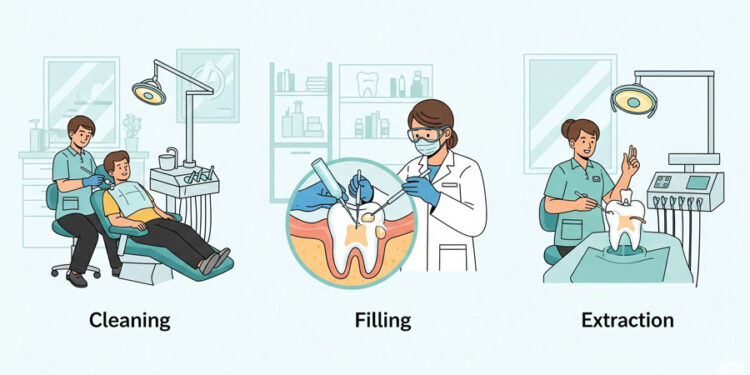
- The Exam: Your dentist will first conduct a thorough examination of your mouth, looking for signs of cavities, gum disease, and other oral health issues. They may also take X-rays to see what’s happening beneath the surface of your teeth and gums.
- The Cleaning: A dental hygienist will use specialized tools to remove plaque and tartar (hardened plaque) from your teeth, both above and below the gum line. They will then polish your teeth with a gritty paste to remove surface stains and finish by flossing between your teeth.
- What to Expect: The cleaning may involve some scraping sounds and a bit of pressure, but it should not be painful. The polishing feels similar to a thorough brushing. The entire process typically takes about 30 to 60 minutes.
2. Fillings
Fillings are used to repair a tooth that has been damaged by decay (a cavity) or minor fractures.
- What It Involves: First, the dentist will numb the area around the tooth with a local anesthetic to ensure you don’t feel any pain. They will then use a drill to remove the decayed portion of the tooth. Once the decay is gone, the dentist will fill the space with a restorative material, such as composite (tooth-colored) or amalgam (silver-colored).
- What to Expect: You will feel a small pinch from the numbing injection, followed by a sensation of pressure or vibration as the dentist works. The numbness will wear off within a few hours.
3. Root Canal Therapy
This procedure is performed to save a tooth that is severely infected or decayed to the point that the pulp (the soft tissue inside the tooth) is affected.
- What It Involves: After numbing the area, the dentist makes an opening in the crown of the tooth to access the infected pulp. They will then carefully remove the infected tissue, clean and shape the inside of the tooth, and fill the space with a sterile, rubber-like material. The tooth is then sealed. In most cases, a crown will be placed over the tooth later to protect it.
- What to Expect: Despite its reputation, a root canal is not a painful procedure. The anesthetic ensures you are comfortable throughout the treatment. You may experience some soreness for a few days afterward, but this can be managed with over-the-counter pain medication.
4. Crowns
A crown is a custom-made cap that fits over a damaged or weakened tooth to restore its shape, size, strength, and appearance.
- What It Involves: This procedure typically requires two visits. During the first visit, the dentist will prepare the tooth by reshaping it to make room for the crown. They will then take an impression of your tooth, which is sent to a lab to create the permanent crown. A temporary crown is placed to protect the tooth. During the second visit, the temporary crown is removed, and the permanent one is cemented into place.
- What to Expect: You’ll receive a local anesthetic for both visits. The process is straightforward, and the temporary crown will feel a bit different but allows you to continue eating and brushing normally until the permanent crown is ready.
5. Tooth Extractions
A tooth extraction is the removal of a tooth. This is done when a tooth is too damaged to be saved by other treatments, or for orthodontic reasons.
- What It Involves: The dentist will first numb the area. Then, using special tools, they will carefully and gently loosen the tooth and remove it. They will then provide you with instructions on how to care for the extraction site.
- What to Expect: You should not feel any sharp pain during the procedure, only a feeling of pressure. Afterward, you will need to follow your dentist’s post-operative instructions carefully to ensure proper healing and avoid complications.
Open communication is key to a comfortable dental visit. Don’t hesitate to ask your dentist questions about any procedure you are undergoing.