
Choosing dental implants is a life-changing decision. Unlike dentures or bridges, implants are designed to mimic the entire structure of a tooth—from the root to the crown. But as with any surgical procedure, there is a period of adjustment.
At Stavya Dental Clinic, the most common question we hear after a successful placement is: “When will this actually feel like my own tooth?” Here is a timeline of what to expect during your transition.
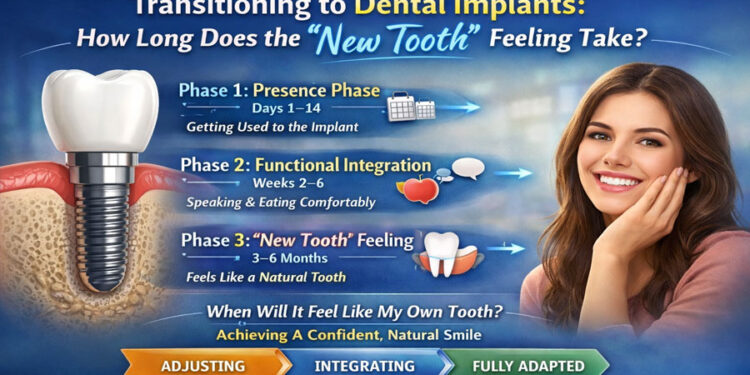
Phase 1: The “Presence” Phase (Days 1–14)
Immediately after the crown (the visible tooth) is attached to the implant post, your mouth will be hyper-aware of the change.
- The Sensation: You might feel a slight “bulkiness.” Your tongue, which is incredibly sensitive to changes in the mouth, will likely wander to the new tooth constantly.
- The Adjustment: This is mostly neurological. Your brain is mapping the new shape and height of the restoration.
- Our Tip: Stick to softer foods for the first few days to allow the surrounding gum tissue to settle around the new crown.
Phase 2: Functional Integration (Weeks 2–6)
This is the stage where you stop “thinking” about the tooth and start “using” it.
- Speech: If the implant is in the front, you might have noticed a slight lisp or change in certain sounds (like “S” or “V”). By week three, your tongue and lips usually adapt, and your speech returns to normal.
- Chewing: You will begin to trust the implant. Because it is anchored directly into the bone through a process called osseointegration, it provides a biting force nearly identical to a natural tooth.
Phase 3: The “New Tooth” Feeling (3–6 Months)
By this point, the “transition” is complete. The “new tooth” feeling usually arrives when the following occurs:
- Proprioception Gap Closes: Natural teeth have a periodontal ligament that senses pressure. Implants do not have this ligament, so they feel slightly “solid” or “stiffer.” By six months, your brain adjusts to this feedback, and the difference becomes imperceptible.
- Tissue Maturity: The gum tissue has completely contoured around the base of the crown, making it feel like a seamless part of your anatomy.
- The “Forgot It’s There” Test: This is the ultimate goal. You’ll realize you’ve gone a whole day without thinking about your implant. That is when you know it has truly become part of you.
Why Some Transitions Take Longer
Every patient at Stavya Dental Clinic is unique. A few factors can influence your timeline:
- Bone Density: Stronger bone can lead to faster stability.
- Number of Implants: A single tooth is often easier to adapt to than a full-arch restoration (All-on-4).
- Position: Molars are usually forgotten faster than front teeth because they aren’t involved as much in speech or the “aesthetic” check in the mirror.
The Stavya Standard
We don’t just place implants; we ensure they fit your life. Our precision-guided surgery and custom-milled crowns are designed to minimize the adjustment period, getting you back to a natural, confident smile as quickly as possible.