As parents, we meticulously track every milestone in our children’s lives—their first steps, their first words, and the loss of their very first baby tooth. We invest deeply in their education, nutrition, and emotional well-being to give them the best possible start in life. Yet, one critical aspect of a child’s development that frequently flies under the radar until adolescence is their structural oral development.
A child’s smile is more than just an aesthetic feature; it is a complex biomechanical system involving the teeth, gums, jawbones, and facial muscles. How these elements grow and align determines not only how your child looks, but also how they chew, speak, breathe, and feel about themselves.
Many parents believe that orthodontic evaluations are a rite of passage reserved strictly for teenagers who need braces. This is a common misconception that can lead to missed opportunities for simpler, non-invasive corrective care. In reality, structural issues are much easier to fix when a child’s jaw is still actively growing.
In this comprehensive guide, Stavya Dental Hospital breaks down the essential orthodontic warning signs every parent should watch for, the science behind early intervention, and how you can safeguard your child’s oral health for a lifetime.
The Critical Timeline: Why Age 7 is the Golden Standard
Before diving into the specific warning signs, it is vital to understand when parents should begin paying closer attention to their child’s orthodontic development.
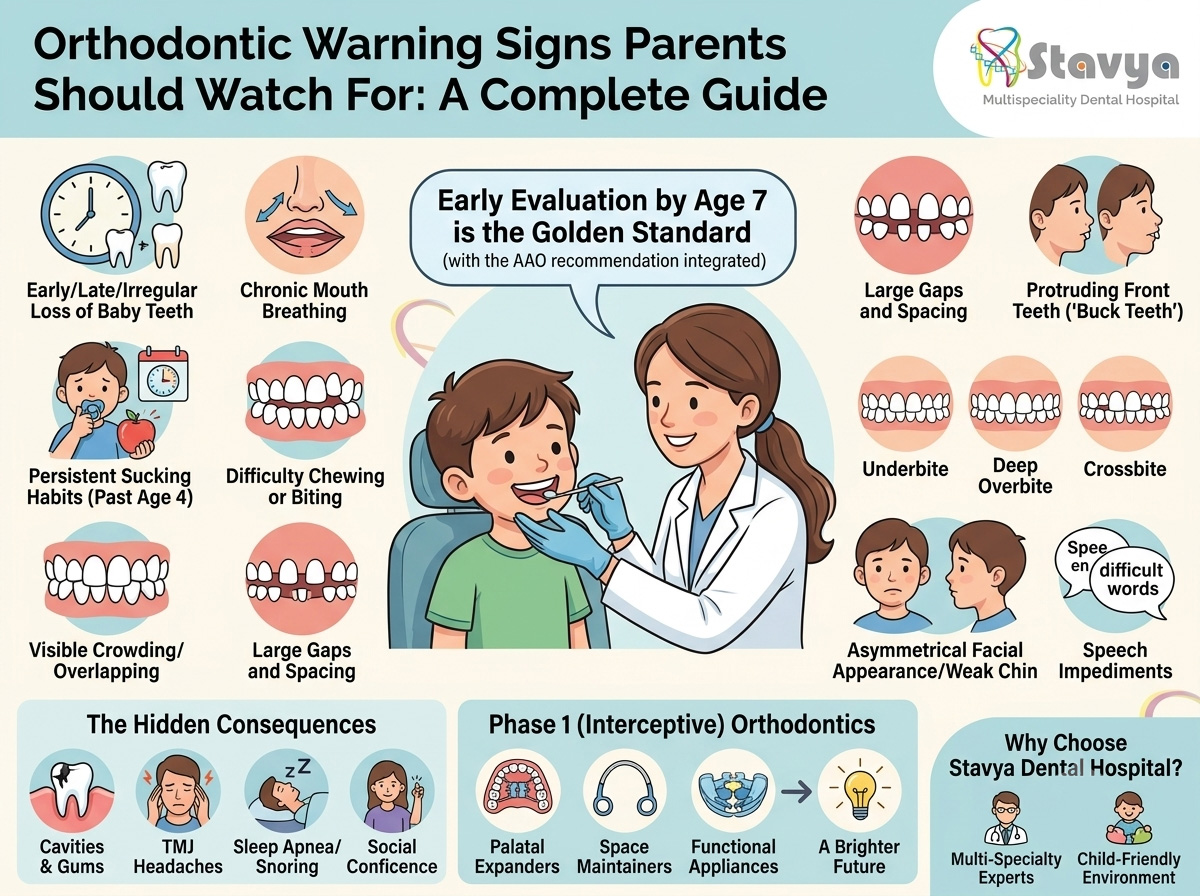
The American Association of Orthodontists (AAO) recommends that every child receive an orthodontic evaluation by the age of 7.
Why age 7? By this stage, most children have a mix of primary (baby) teeth and permanent (adult) teeth. This transitional dentition provides an expert orthodontist with a clear blueprint of how the adult teeth are erupting and how the upper and lower jaws are growing in relation to one another.
At age 7, your child’s jawbones are still malleable and growing rapidly. If a structural discrepancy is detected early, a specialist can guide jaw growth using subtle, interceptive appliances. Waiting until all the permanent teeth have erupted (usually around ages 12 to 14) means the jaw bones have begun to fuse, turning what could have been a simple, preventive correction into a complex, prolonged, and sometimes surgical treatment plan.
10 Major Orthodontic Warning Signs Every Parent Must Know
As a parent, you do not need a medical degree to spot the early indicators of orthodontic trouble. By paying close attention during daily routines—like family meals, bedtime, or when your child speaks—you can identify subtle shifts.
Here are the ten most critical warning signs that demand a professional evaluation by a specialized orthodontist:
1. Early, Late, or Irregular Loss of Baby Teeth
Baby teeth serve a fundamental purpose beyond chewing: they act as natural space maintainers for the adult teeth waiting underneath.
- Early Loss: If a child loses a baby tooth prematurely due to decay or injury, the neighboring teeth can drift into the empty space. This blocks the path for the permanent tooth, leading to severe impaction or crowding.
- Late Loss: If baby teeth refuse to fall out long after they are due, they can force the underlying permanent teeth to erupt sideways, backwards, or completely out of alignment.
2. Chronic Mouth Breathing
If your child consistently breathes through their mouth rather than their nose—whether resting, watching TV, or sleeping—it is a significant red flag.
Mouth breathing alters the resting position of the tongue, lips, and cheeks. Over time, the constant pressure of the cheeks without the counter-balancing upward pressure of the tongue can cause the upper jaw to grow narrow and V-shaped. This structural shift leads to high-arched palates, severe crowding, and a recessed lower jaw, profoundly altering their facial profile.
3. Persistent Thumb, Finger, or Pacifier Sucking (Past Age 4)
Sucking is a natural, soothing reflex for infants. However, if these habits persist past the age of 3 or 4, when permanent structural development begins, the sustained pressure can severely warp the jawbone.
This habit frequently leads to an “open bite,” a condition where the front upper and lower teeth cannot touch even when the back teeth are completely clenched together. It can also cause the upper front teeth to flare outward dramatically, making them highly susceptible to accidental fractures.
4. Difficulty Chewing, Biting, or Frequent Cheek Biting
Mealtime can provide excellent insight into your child’s structural alignment. Watch for these subtle cues:
- Does your child struggle to chew efficiently?
- Do they shift their jaw sideways just to grind their food?
- Do they complain about frequently biting the insides of their cheeks or lips?
These behaviors strongly indicate a misaligned bite (malocclusion), where the teeth do not fit together smoothly, causing the muscles to work in a dysfunctional pattern.
5. Visible Crowding, Overlapping, or Misplaced Teeth
This is often the most obvious sign for parents. When a child’s jaw is too small to accommodate their permanent teeth, the incoming adult teeth will fight for space, twisting, overlapping, or erupting entirely out of the normal archline. Crowded teeth are incredibly difficult to clean thoroughly, significantly skyrocketing your child’s risk for early cavities and gum inflammation.
6. Large Gaps and Spacing Issues
While some spacing is completely normal and even desirable in a young child’s smile (to leave room for larger adult teeth), excessive, wide gaps after the permanent teeth have erupted can point to structural issues. This could be caused by microdontia (abnormally small teeth), missing permanent teeth beneath the gums, or an oversized jaw arch.
7. Protruding Front Teeth (“Buck Teeth”)
When the upper teeth stick out significantly ahead of the lower teeth, it is often a sign of an overjet or an underdeveloped lower jaw. Beyond the aesthetic impact, protruding teeth are an immediate safety hazard. Children are naturally active, and teeth that flare outward are the first to absorb the impact during sports, playground falls, or accidental trips.
8. Jaw Discrepancies: Underbites, Overbites, and Crossbites
Take a close look at your child’s bite from the front and sides when their mouth is fully closed:
- Underbite: The lower front teeth sit ahead of or overlap the upper front teeth.
- Deep Overbite: The upper front teeth completely cover the lower front teeth, sometimes causing the lower teeth to bite directly into the roof of the mouth.
- Crossbite: The upper teeth fit inside the lower teeth on one or both sides, causing the child to shift their lower jaw uncomfortably to one side to function.
9. Asymmetrical Facial Appearance or Weak Chin
Orthodontics is as much about facial orthopedics as it is about straightening teeth. If you notice that your child’s face looks visibly asymmetrical from the front, or if their profile reveals an severely recessed chin or a protruding mouth, the root cause is almost always an underlying skeletal jaw imbalance that needs to be addressed while the bone is growing.
10. Speech Impediments or Lisps
While many speech issues are developmental and resolved with time or speech therapy, some are strictly mechanical. If a child has a severe lisp, slurs certain words, or struggles to pronounce specific sounds (like s, z, t, or ch), it may be because an open bite, crossbite, or severe crowding is physically preventing their tongue from making proper contact with the palate or teeth.
The Hidden Consequences of Ignoring Early Warning Signs
Many parents choose a “wait and see” approach, assuming that all orthodontic problems can be completely ironed out once the child reaches high school. However, ignoring early warning signs can have compounding physical and psychological effects as a child grows:
Chronic Cavities and Periodontal Issues
When teeth are tightly crowded or severely rotated, even the most meticulous brushing and flossing routines cannot reach the tight, trapped crevices. Over time, plaque accumulation leads to chronic decay, bad breath, and early-onset gum disease.
Temporomandibular Joint (TMJ) Disorders
An uncorrected malocclusion forces the jaw joints and chewing muscles to work at an unnatural, stressed angle. Over the years, this constant strain can manifest as chronic headaches, jaw clicking, facial pain, and premature wear and tear on the tooth enamel.
Sleep Disordered Breathing and Sleep Apnea
Skeletal imbalances, such as a narrow upper palate or a severely recessed lower jaw, directly restrict the airway space at the back of the throat. This can lead to heavy snoring, restless sleep, night terrors, and pediatric sleep apnea. Children deprived of deep, restful sleep often exhibit poor concentration, behavioral issues, and hyperactive symptoms at school that mimic ADHD.
Psychological and Social Impact
Children can be acutely perceptive, and unfortunately, dental misalignments are a common target for schoolyard teasing. A child who is self-conscious about their protruding or crowded teeth may develop a habit of covering their mouth when laughing, avoiding photos, and withdrawing from social interactions, heavily damaging their self-esteem during their formative years.
What is Phase 1 (Interceptive) Orthodontics?
When you bring your child to Stavya Dental Hospital at an early age and an issue is detected, our specialists often implement what is known as Phase 1 Interceptive Orthodontics.
Phase 1 treatment does not necessarily mean putting full metal braces on a 7-year-old. Instead, it utilizes specialized, often removable appliances designed to work harmoniously with your child’s natural growth spurts. Examples include:
- Palatal Expanders: Lightly widens a narrow upper jaw to eliminate crossbites and create natural room for crowded teeth to erupt without extractions.
- Space Maintainers: Holds open the natural gaps left by prematurely lost baby teeth so adult teeth can erupt perfectly straight.
- Functional Appliances: Guides the growth of the upper or lower jaws relative to one another to correct severe overbites or underbites naturally.
By completing Phase 1 treatment, we simplify, shorten, and sometimes completely eliminate the need for full braces (Phase 2) later in their teenage years.
Why Choose Stavya Dental Hospital for Your Child’s Smile?
When it comes to your child’s developmental health, you deserve a team that combines clinical precision with deep empathy. Stavya Dental Hospital is recognized as a leading multispecialty facility in Ahmedabad, completely equipped to manage your child’s dental journey from infancy through adulthood.
Here is why families trust Stavya with their children’s smiles:
1. Dedicated Pediatric and Orthodontic Specialists
Children are not just miniature adults; they require unique medical understanding and a gentle psychological approach. At Stavya, your child will be evaluated by an expert team comprising dedicated Pedodontists (child tooth specialists) and Orthodontists (alignment specialists) working collaboratively under one roof.
2. A Warm, Anxiety-Free Environment
We know that a visit to the dentist can feel daunting to a young child. Our hospital features a welcoming, child-friendly environment designed to dismantle fear instantly. Our staff is trained in positive behavioral guidance, ensuring your child feels safe, heard, and completely comfortable throughout their visit.
3. State-of-the-Art Diagnostics
We utilize ultra-low-radiation digital imaging and non-invasive intraoral scanners. This means no messy, uncomfortable putty molds for your child, and precise, instant 3D mapping of their jaw structural growth for our specialists.
4. Conservative, Growth-Driven Approach
At Stavya Dental Hospital, we believe in conservative, evidence-based care. We never recommend premature treatments unless absolutely necessary for your child’s long-term health. If your child is not ready for treatment, we place them in our complimentary monitoring program, tracking their growth periodically to step in at the absolute perfect biological window.
Simple At-Home Screening Checklist for Parents
To help you monitor your child’s smile, review this quick at-home checklist every few months:
- [ ] Does my child struggle to bite into an apple or chew tough food?
- [ ] Is my child still sucking their thumb or fingers past their fourth birthday?
- [ ] When my child closes their mouth normally, do the front teeth fail to meet?
- [ ] Does my child frequently breathe through their mouth or snore loudly at night?
- [ ] Are the teeth visibly crowded, overlapping, or erupting out of place?
- [ ] Does my child’s jaw shift to one side when they close their mouth?
- [ ] Has my child lost baby teeth unusually early due to an injury or cavity?
If you checked “Yes” to even one of these questions, it is highly recommended to schedule a non-invasive, professional orthodontic screening.
Conclusion: Give Your Child the Gift of a Confident Future
An investment in early orthodontic care is an investment in your child’s lifelong health, confidence, and happiness. Recognizing the early warning signs and stepping in at the right time ensures a smoother, shorter, and highly predictable path to a flawless smile.
At Stavya Dental Hospital, we treat your children like our own. Our team of specialists is ready to guide you through every stage of your child’s oral development, ensuring they grow up with a healthy bite and a radiant, confident smile that they will carry proudly for the rest of their lives.
Don’t wait for developmental hitches to become permanent problems. Secure your child’s smile milestones today.
Schedule an Early Orthodontic Evaluation at Stavya Dental Hospital
Our friendly, expert team is just a call away. Get in touch with us to book a comprehensive developmental screening for your child.
- Website: www.stavyadental.com
- Phone / WhatsApp: +91 8980395039
- Address: Upper floor, Tirthjal Complex, Opp. ICICI Bank, 132 ft. Ring Road, Way to Shivranjani Cross Road, Satellite, Ahmedabad – 380015