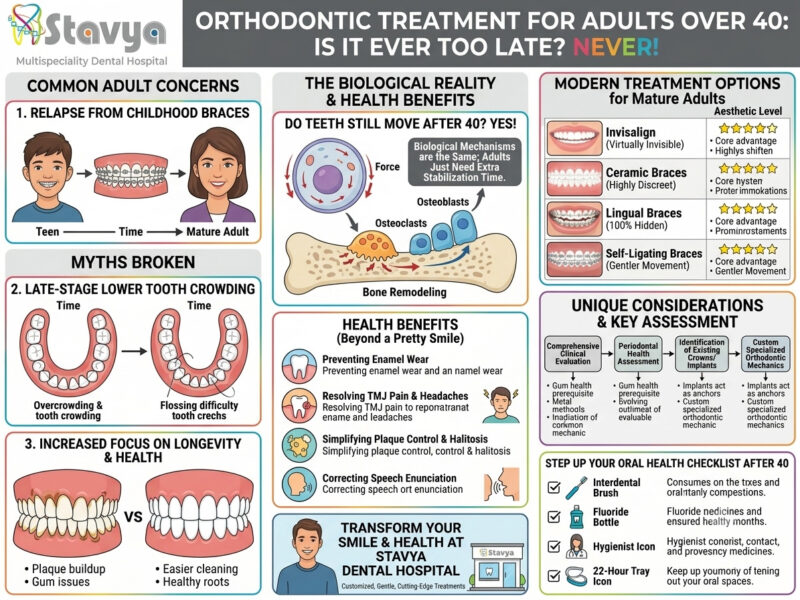
Deciding to straighten your teeth is a powerful investment in your oral health, facial symmetry, and self-esteem. A well-aligned smile not only enhances your appearance but also significantly improves your ability to chew, speak, and maintain optimal oral hygiene, reducing the risk of gum disease and tooth decay over time.
When exploring orthodontic treatments, patients are frequently presented with two of the most dependable, time-tested options: Traditional Metal Braces and Aesthetic Ceramic Braces. Both systems rely on a sophisticated framework of brackets and archwires to safely guide teeth into their ideal positions. However, they differ considerably when it comes to material composition, visual impact, durability, and daily maintenance.
At Stavya Dental Hospital, we treat orthodontics as a careful blend of dental science and facial artistry. We believe that choosing the right braces requires looking at both clinical needs and your daily lifestyle. This evidence-based, comprehensive guide compares ceramic and metal braces side-by-side to help you make an informed decision for your orthodontic journey.
1. The Core Mechanics: How Fixed Orthodontics Work
Before exploring the differences, it helps to understand what metal and ceramic braces have in common. Both systems fall under the category of fixed orthodontic appliances. Unlike removable clear aligners, fixed braces remain continuously bonded to your teeth throughout the treatment timeline, giving the orthodontist highly precise, three-dimensional control over tooth movement.
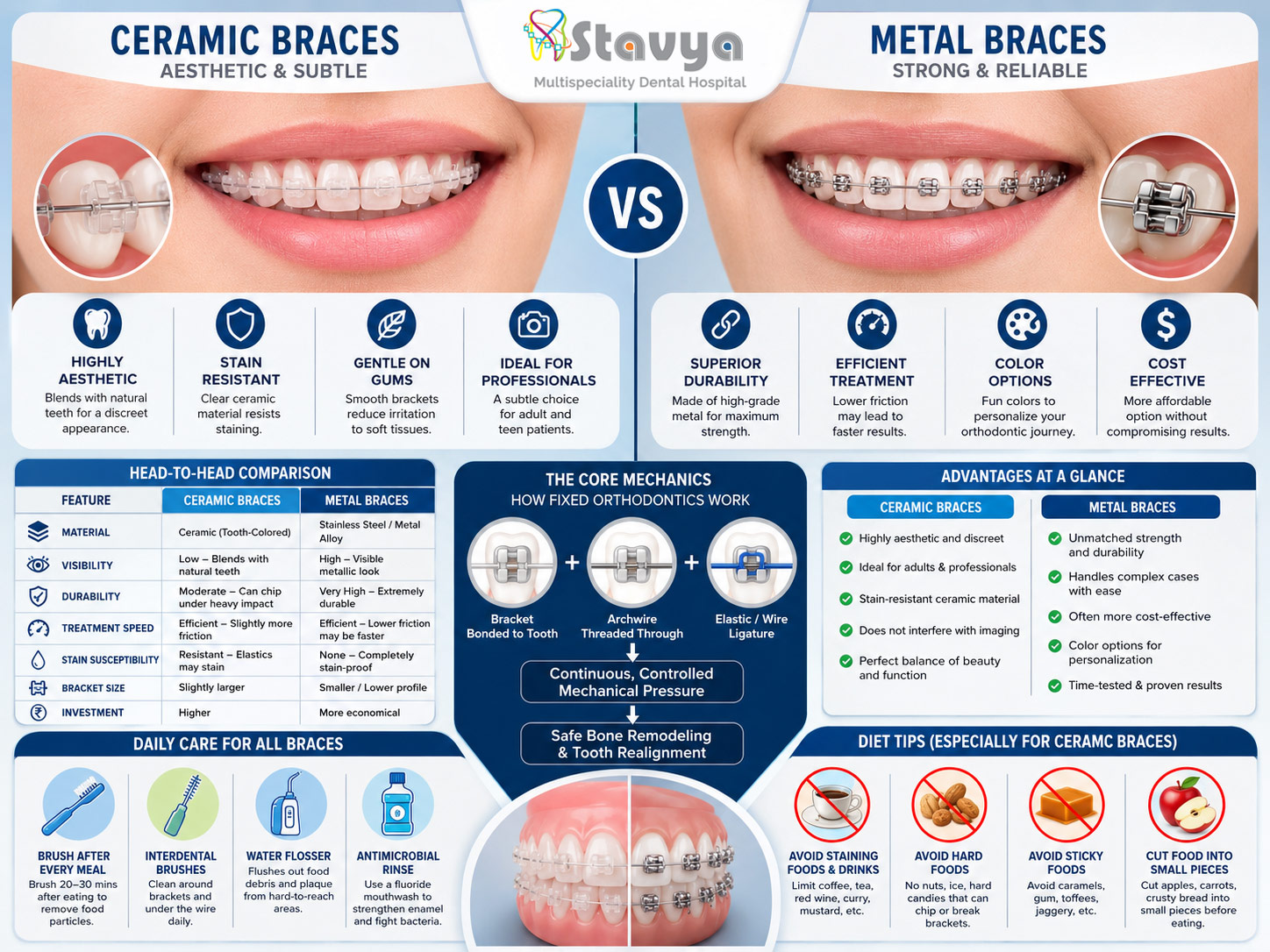
[Bracket Bonded to Tooth] + [Archwire Threaded Through] + [Elastic/Wire Ligature]
                                        |
                 [Continuous, Controlled Mechanical Pressure]
                                        |
                 [Safe Bone Remodeling & Tooth Realignment]
Every fixed orthodontic system relies on three fundamental components:
- The Brackets: Small square anchors bonded directly to the front surface of each tooth using a specialized, medical-grade dental adhesive.
- The Archwire: A flexible metal wire threaded through each bracket slot. This wire acts as the primary engine of movement, exerting continuous, gentle pressure to guide teeth into alignment.
- The Ligatures (O-Rings): Tiny elastic bands or wire ties wrapped around each bracket to secure the archwire firmly in place.
Whether you choose metal or ceramic, the underlying biological process—called bone remodeling—remains the same. The gentle pressure of the archwire causes the bone on one side of the tooth root to dissolve slightly, allowing the tooth to move, while new bone tissue forms behind it to lock it securely into its new position.
2. Deep Dive: Traditional Metal Braces
Traditional metal braces are the foundational bedrock of modern orthodontics. Made from high-grade, premium stainless steel or titanium alloys, they are engineered to withstand incredible mechanical forces over long treatment periods.
Advantages of Metal Braces
- Unmatched Structural Durability: Metal brackets are virtually indestructible under normal chewing conditions. They can withstand the heavy forces required to correct severe bite misalignments, making bracket fractures incredibly rare.
- Maximum Clinical Efficiency: Because metal slots create minimal friction against metal archwires, teeth can shift smoothly along the wire. This low friction often translates to slightly faster tooth movement, particularly in complex cases involving heavy rotation or deep bite corrections.
- Most Cost-Effective Option: Metal braces remain the most economical orthodontic choice, offering exceptional, highly predictable results without the material premium associated with ceramic or clear aligner systems.
- Customization with Colors: For younger patients and teenagers, metal braces offer a fun avenue for personal expression. The elastic ligatures come in a wide palette of vibrant colors that can be changed during every routine adjustment appointment.
Disadvantages of Metal Braces
- High Visual Prominence: The most notable drawback of metal braces is their bold, metallic appearance. They are highly visible when smiling, speaking, or laughing, which can make some adult professionals or self-conscious teenagers hesitant to choose them.
- Initial Soft Tissue Discomfort: Because metal brackets stick out slightly from the teeth, they can rub against the inner lips and cheeks during the first few weeks of treatment, causing temporary irritation or small mouth sores until the soft tissues toughen up.
3. Deep Dive: Aesthetic Ceramic Braces
Introduced as a discreet alternative to metal, ceramic braces utilize advanced material science to blend in seamlessly with your natural smile. The brackets are made from polycrystalline or monocrystalline alumina ceramics, engineered to replicate the translucent optical properties of natural tooth enamel.
Advantages of Ceramic Braces
- High Aesthetic Discretion: The greatest benefit of ceramic braces is their subtle appearance. Because the brackets match your tooth color or are completely translucent, they disappear into your smile from a distance. When paired with frosted or white-coated archwires, they become incredibly difficult to notice.
- Excellent Solution for Professionals: For working adults, public speakers, and older teenagers who want to avoid a “metallic” look but still require the precise moving power of fixed braces, ceramic braces offer the perfect middle ground.
- Stain-Resistant Materials: Modern, high-quality ceramic brackets are non-porous and highly resistant to discoloration from food pigments, ensuring they maintain their clarity throughout your treatment.
- Minimal Radiographic Interference: Ceramic materials do not interfere with advanced medical or dental imaging scans, providing clean diagnostic readouts if secondary health imaging is needed.
Disadvantages of Ceramic Braces
- Increased Structural Fragility: While highly durable, dental ceramic behaves like glass under extreme, sudden pressure. Ceramic brackets are more prone to chipping or fracturing if you accidentally bite down hard on an unyielded food item, which may require a clinic visit for a replacement.
- Slightly Higher Friction: The contact between a metal archwire and a ceramic bracket slot creates more mechanical friction than a metal-on-metal system. In some complex orthodontic cases, this added resistance can subtly extend the overall treatment timeline.
- Larger Bracket Profile: To compensate for being inherently more brittle than steel, ceramic brackets are designed with a slightly bulkier profile to ensure structural strength, which some patients notice against their inner lips initially.
- Care Required for Elastic Ties: While the ceramic bracket itself will not stain, the clear or tooth-colored elastic ligatures wrapped around them can absorb pigments from dark foods, requiring mindful dietary habits between adjustment visits.
4. Head-to-Head Comparison: Ceramic vs. Metal Braces
To help you visualize the practical differences, here is a detailed breakdown across key clinical and lifestyle factors:
| Feature / Consideration | Traditional Metal Braces | Aesthetic Ceramic Braces |
| Material Composition | High-grade Stainless Steel / Titanium Alloy | Translucent Polycrystalline Alumina Ceramic |
| Aesthetic Visibility | Highly visible; distinct metallic appearance. | Highly discreet; blends with natural enamel color. |
| Structural Durability | Maximum; virtually impossible to break or chip. | Moderate; can chip or fracture under heavy impact. |
| Treatment Velocity | Maximum efficiency; lowest friction speeds movement. | Highly efficient; slightly higher friction in complex cases. |
| Stain Susceptibility | Completely stain-proof. | Bracket is stain-resistant; clear elastic ties can discolor. |
| Bracket Size | Low profile; smaller and flatter on the teeth. | Slightly larger and bulkier to maintain material strength. |
| Investment Level | Most economical and budget-friendly option. | Premium option due to advanced material manufacturing. |
5. Daily Maintenance and Dietary Care for Braces
Regardless of the system you choose, wearing fixed braces requires an upgrade to your daily oral hygiene routine and minor adjustments to your eating habits to prevent cavities and protect the appliances.
The Orthodontic Hygiene Protocol
Food particles and plaque easily become trapped around brackets and beneath archwires. If left unmanaged, this can lead to enamel demineralization, leaving permanent white spots (white spot lesions) on your teeth once the braces are removed.
- Brush After Every Meal: Carry a travel toothbrush and brush 20 to 30 minutes after eating to clear away trapped debris before bacteria can generate harmful acids.
- Utilize Interdental Brushes: These tiny, Christmas-tree-shaped micro-brushes are invaluable for sweeping out plaque from the hard-to-reach spaces directly underneath the archwire and around the edges of the brackets.
- Incorporate a Water Flosser: A water flosser uses a targeted stream of pressurized water to easily flush away loose food particles from orthodontic hardware, making daily flossing much simpler.
Mindful Eating Habits for Ceramic Braces
If you choose ceramic braces, you must pay extra attention to what you eat to keep the clear elastic ties looking pristine:
- Minimize Staining Agents: Limit your consumption of dark coffee, black tea, red wine, mustard, and heavy curries containing turmeric. If you do enjoy these foods, rinse your mouth vigorously with water immediately afterward.
- Avoid Hard and Sticky Foods: Steer completely clear of sticky caramels, hard nuts, ice cubes, and tough candies that can cleanly snap a bracket off a tooth. Always slice whole apples, carrots, and crusty bread into thin, bite-sized pieces rather than biting directly into them with your front teeth.
6. Your Orthodontic Journey at Stavya Dental Hospital
At Stavya Dental Hospital, we treat orthodontic care as a customized, patient-centered experience. Our advanced diagnostic imaging—including high-resolution digital X-rays and 3D Cone Beam Computed Tomography (CBCT)—allows our orthodontic specialists to map your entire dental and jaw structure with absolute precision.
During your initial consultation, we don’t just look at your teeth; we evaluate your facial profile, your daily professional demands, your aesthetic preferences, and your long-term health goals. Our team takes the time to explain the clinical path ahead, ensuring that whether you select the unbeatable durability of traditional metal or the elegant discretion of ceramic, your treatment is perfectly tailored to your lifestyle.
Take the First Step Toward a Straighter, Healthier Smile
Ready to explore your options for a beautifully aligned smile? Schedule a comprehensive orthodontic evaluation with our expert team today.
- Explore Our Services Online: www.stavyadental.com
- Connect with Our Helpline Directly: +91 8980395039