Tooth decay remains one of the most widespread chronic health conditions globally. Despite advancements in public health, water fluoridation, and oral hygiene awareness, millions of children and adults experience dental caries (cavities) every year. While regular brushing and flossing are foundational to excellent oral health, standard toothbrushes often cannot reach the deepest, most vulnerable areas of the mouth—the complex pits and fissures of the chewing surfaces of your back teeth.
This is where preventative dental treatments become essential. Dental sealants offer a highly effective, clinically proven line of defense against tooth decay. By creating a smooth, protective barrier over the grooved surfaces of the molars and premolars, sealants effectively shut out cavity-causing bacteria and food particles.
At Stavya Dental Hospital, our core clinical philosophy centers on conservative, preventative dentistry. We believe that preventing an infection is always superior to treating a damaged tooth structure. This comprehensive, evidence-based guide breaks down the science behind dental sealants, how they work, who benefits from them most, and how they protect your smile for the long term.
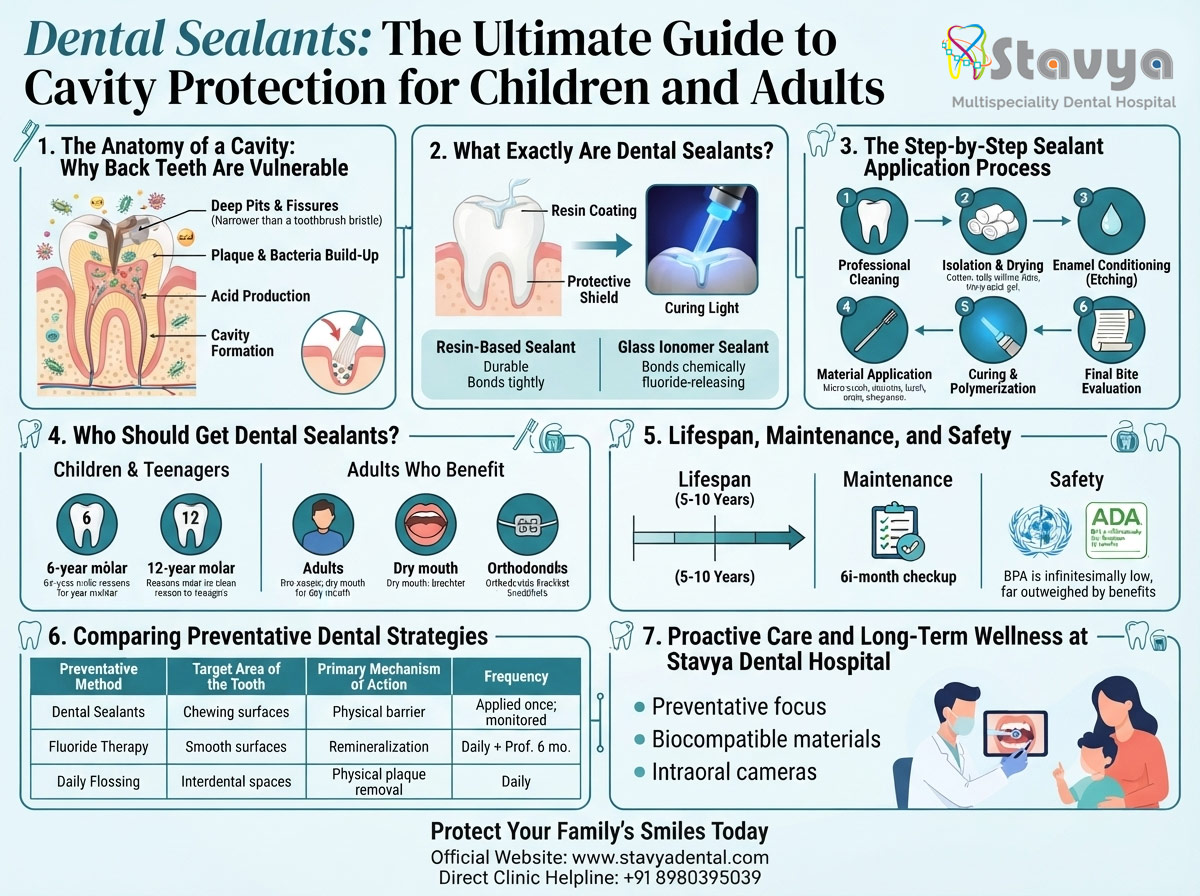
1. The Anatomy of a Cavity: Why Back Teeth Are Vulnerable
To understand why dental sealants are so critical, it helps to examine the microscopic topography of your back teeth—specifically your molars and premolars.
[Tooth Surface] -> Deep Pits & Fissures (Narrower than a toothbrush bristle)
      |
[Plaque & Bacteria Build-Up] -> Trapped food particles cannot be brushed away
      |
[Acid Production] -> Bacteria feed on sugars, producing enamel-eroding acids
      |
[Cavity Formation] -> De-mineralization leads to structural decay
The chewing surfaces of these teeth are naturally designed with grooves called pits and fissures. These anatomical depressions help crush and grind down food during mastication. However, these grooves can be exceptionally deep, narrow, and winding.
In many cases, a single fissure is narrower than a single bristle of a standard toothbrush. This means that no matter how thoroughly or frequently you brush, the bristles physically cannot penetrate to the bottom of these microscopic valleys to sweep out trapped food debris and plaque.
When anaerobic oral bacteria—such as Streptococcus mutans—settle into these deep grooves, they feed on the residual sugars left behind from foods. As they metabolize these carbohydrates, they produce organic acids as a byproduct. These localized acids slowly erode the protective outer enamel layer, leading to mineral loss (demineralization) and eventually creating a physical cavity. According to clinical data, over 80% of cavities in children’s teeth occur within these specific pits and fissures.
2. What Exactly Are Dental Sealants?
A dental sealant is a thin, medical-grade plastic or biocompatible resin coating applied directly to the chewing surfaces of the back teeth. Once applied, it flows fluidly into the deep pits and valleys, filling them completely. The material is then hardened using a specialized curing light, creating an impenetrable, smooth shield over the tooth.
Think of a dental sealant as a protective rain cover for your tooth’s natural anatomy. It does not alter your ability to chew, nor does it look unnatural. Instead, it turns a complex, grooved, hard-to-clean surface into a smooth, even plain that is easy to keep free of plaque with standard brushing.
Resin-Based vs. Glass Ionomer Sealants
Modern preventative dentistry typically utilizes two primary types of sealant materials:
- Resin-Based Sealants: Made from specialized dental plastics, these sealants are highly durable, smooth, and bond tightly to the enamel structure. They are ideal for fully erupted teeth where a dry environment can be tightly maintained during application.
- Glass Ionomer Sealants: These sealants are formulated from a biocompatible glass mixture that chemically bonds to the tooth. Their greatest clinical advantage is that they continuously release fluoride into the surrounding tooth structure over time, helping to remineralize and strengthen the enamel. They are often used when a tooth is only partially erupted or when moisture control is challenging.
3. The Step-by-Step Sealant Application Process
One of the greatest benefits of dental sealants is that the application process is completely non-invasive, quick, and entirely pain-free. There is no need for local anesthesia (numbing injections), and no natural tooth structure is drilled or removed.
At Stavya Dental Hospital, our specialists follow a meticulous clinical protocol to ensure maximum longevity for the sealant bond:
Step 1: Professional Cleaning
The target tooth is thoroughly cleaned using a rotating dental brush and a non-flavored prophylactic paste. This removes all loose plaque, food debris, and organic films from the depths of the fissures.
Step 2: Isolation and Drying
The tooth is isolated from the rest of the mouth using cotton rolls or a dental dam. This is a critical step because the sealant material requires a completely dry environment to bond successfully with the enamel.
Step 3: Enamel Conditioning (Etching)
A mild, blue-tinted conditioning gel (usually a safe phosphoric acid solution) is applied to the chewing surface for a few seconds. This microscopic etching process roughens the surface of the enamel slightly, creating a texturized canvas that allows the sealant material to form a powerful mechanical bond with the tooth. The gel is then thoroughly rinsed away with water, and the tooth is dried again.
Step 4: Material Application
The liquid dental sealant material is carefully painted directly into the pits and fissures using a micro-applicator tip. The material’s low viscosity allows it to seep deeply into every microscopic crevice.
Step 5: Curing and Polymerization
A specialized ultraviolet (UV) blue curing light is directed onto the tooth for approximately 20 to 30 seconds. The energy from the light triggers a chemical reaction that immediately hardens the liquid resin into a solid, durable protective shield.
Step 6: Final Bite Evaluation
The dentist rinses the area and checks the patient’s bite using articulating paper. This ensures that the thin layer of sealant does not interfere with how the upper and lower teeth meet when chewing. If necessary, minor adjustments are made instantly.
4. Who Should Get Dental Sealants?
While dental sealants are most frequently associated with pediatric dentistry, they are highly beneficial for individuals of all ages depending on their unique oral anatomy and cavity risk factors.
Children and Teenagers
The primary window for placing dental sealants opens as soon as a child’s permanent molars erupt through the gums. This ensures the teeth are protected during their most vulnerable developmental years.
- The First Molars (6-Year Molars): These permanent teeth erupt around age 6. Sealing them early keeps them safe from decay as children learn to master their independent brushing habits.
- The Second Molars (12-Year Molars): These erupt around age 12. Sealing these teeth protects the back of the mouth through the cavity-prone teenage years.
- Primary (Baby) Teeth: In specific clinical scenarios, a pediatric dentist may recommend sealing baby molars if a child exhibits a very high rate of early childhood tooth decay or possesses exceptionally deep grooves, helping to preserve the space holders for future permanent teeth.
Adults Who Benefit from Sealants
It is a common misconception that adults cannot get sealants. If an adult has deep, cavity-free pits and fissures on their molars, sealants can provide an exceptional layer of long-term protection. Adults who are highly susceptible to decay due to medical conditions causing chronic dry mouth (xerostomia), undergoing orthodontic treatment, or who simply want to take a proactive approach to preventative wellness are excellent candidates for dental sealants.
5. Lifespan, Maintenance, and Safety of Dental Sealants
How Long Do Dental Sealants Last?
With proper care, dental sealants are highly durable and can comfortably protect teeth for up to 5 to 10 years. Over time, they can gradually wear down due to the mechanical forces of chewing or become loose if subjected to highly sticky foods.
During your routine six-month dental checkups, your dentist will visually inspect the structural integrity of the sealants. If a sealant has chipped, cracked, or worn away, it can be easily patched or reapplied during a standard cleaning appointment.
Debunking the Myth: Are Sealants Safe?
A common question among parents relates to the presence of Bisphenol A (BPA) in plastic dental resins. Leading global health organizations, including the World Health Organization (WHO) and the American Dental Association (ADA), have conducted extensive safety reviews.
The research shows that the level of BPA exposure from a dental sealant is infinitesimally low—substantially less than the amount a person absorbs daily from common food packaging, dust, or cosmetics. The immense preventative benefit of protecting a child from chronic dental infections and the need for invasive fillings far outweighs any theoretical risk, making sealants a widely recommended standard of care.
6. Comparing Preventative Dental Strategies
To build a complete defense system against tooth decay, it helps to see how different preventative methods complement one another. Sealants do not replace fluoride treatments or home care; rather, they work together to create a multi-layered shield for your smile.
| Preventative Method | Target Area of the Tooth | Primary Mechanism of Action | Frequency |
| Dental Sealants | Chewing surfaces (Pits & Fissures) | Creates a physical barrier that keeps food and bacteria out. | Applied once; monitored or repaired bi-annually. |
| Fluoride Therapy | Smooth surfaces and entire enamel matrix | Chemically hardens the enamel structure and promotes remineralization. | Daily via toothpaste/rinse; professionally every 6 months. |
| Daily Flossing | Interdental spaces (Between the teeth) | Physically removes plaque where adjacent teeth touch. | Daily (Every night before bed). |
7. Proactive Care and Long-Term Wellness at Stavya Dental Hospital
At Stavya Dental Hospital, we treat preventative oral care as a core pillar of your systemic health. Our dedicated pediatric and general dental specialists utilize premium-quality, biocompatible sealant materials designed to offer maximum wear resistance and tight marginal seals.
During our routine diagnostic evaluations, we leverage high-resolution intraoral cameras to show you and your child exactly how the grooves of your teeth look, helping you visualize the benefits of preventative protection. By catching vulnerable enamel early and applying non-invasive protective coatings, we aim to help our patients enjoy a lifetime of healthy smiles completely free of painful cavities and complex restorative procedures.
Protect Your Family’s Smiles Today
Don’t wait for tooth decay to cause discomfort or require expensive fillings. Schedule a preventative dental evaluation for your children or yourself to learn more about how dental sealants can protect your oral health.
- Official Website: www.stavyadental.com
- Direct Clinic Helpline: +91 8980395039