When most people picture orthodontic treatment, they imagine a teenager wearing a mouth full of metallic brackets, navigating school portraits and teenage milestones. For decades, a prevailing dental myth suggested that if you didn’t straighten your teeth during your adolescent years, you missed your window of opportunity entirely.
At Stavya Dental Hospital, we are here to break that misconception definitively: it is never too late to achieve a healthy, beautifully aligned smile.
In recent years, the demographics of orthodontic care have shifted dramatically. Today, more adults over the age of 40, 50, and even 60 are seeking orthodontic treatment than ever before. Whether you want to correct a lifelong cosmetic insecurity, address a shifting bite, or restore function to worn-down teeth, adult orthodontics offers advanced, discreet, and comfortable solutions.
Why More Adults Over 40 Are Choosing Orthodontic Treatment
Your 40s and beyond represent a stage of life where investing in yourself, your health, and your confidence becomes a priority. There are several reasons why individuals over 40 decide it’s finally time to consult an orthodontist:
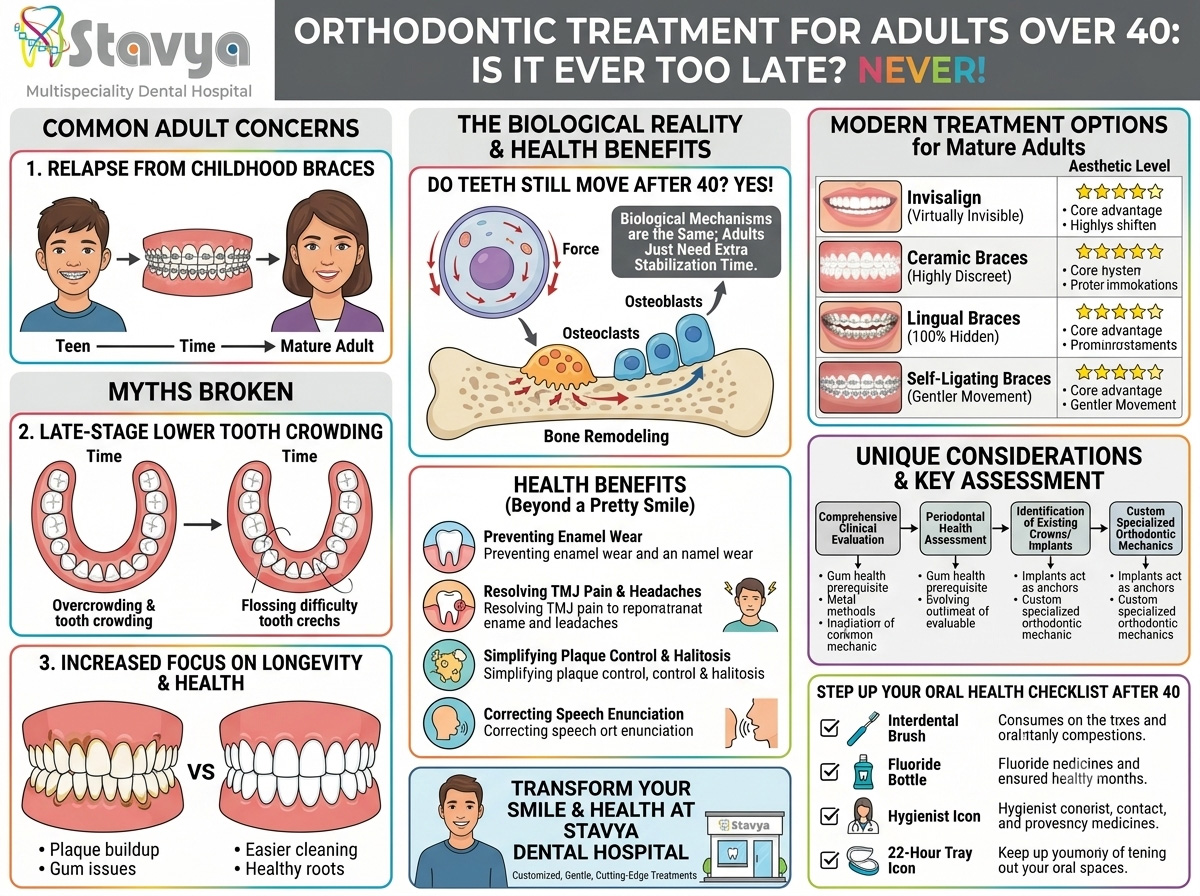
1. Relapse from Childhood Braces
Many adults in their 40s actually underwent orthodontic treatment when they were younger. However, a few decades ago, the dental community did not fully appreciate the necessity of life-long retention. If you stopped wearing your removable retainer in your late teens, your teeth have likely drifted back toward their original positions due to natural aging and jaw changes—a phenomenon known as orthodontic relapse.
2. Late-Stage Lower Tooth Crowding
Even if your teeth were perfectly straight in your 20s, you might notice your lower front teeth bunching up or overlapping as you cross into your 40s. As we age, our lower jaw naturally undergoes a subtle narrowing and mesial drift (a tendency for teeth to move forward). This compresses the lower arch, resulting in sudden crowding that makes flossing difficult.
3. Increased Focus on Overall Longevity and Health
Modern adults are living longer, healthier lives and want their natural teeth to last just as long. Straight teeth are fundamentally easier to clean, which minimizes the risk of tooth loss, periodontal infections, and complex dental issues in your later years.
4. Discreet Treatment Technologies
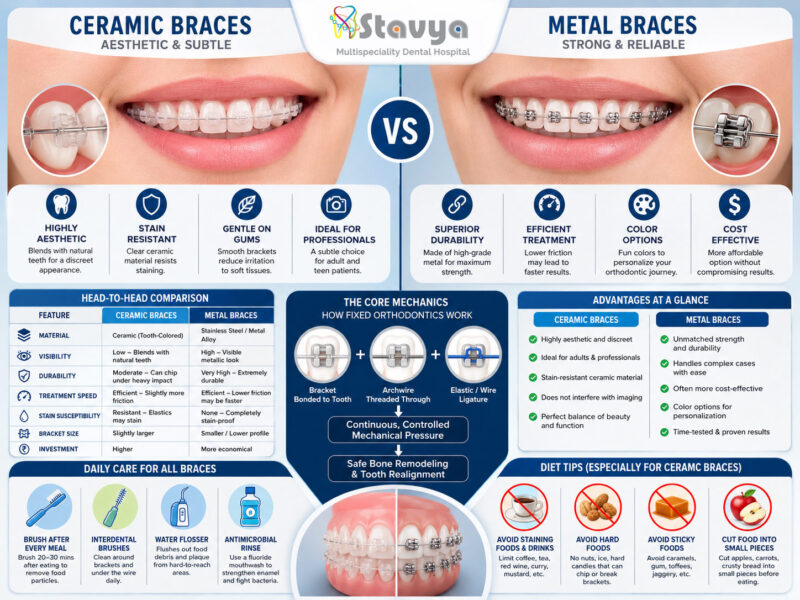
The advent of virtually invisible clear aligners and tooth-colored ceramic brackets has removed the social stigma of adult braces. You can comfortably correct your smile while managing an active professional or social life, without anyone noticing your treatment.
The Biological Reality: Do Teeth Still Move After 40?
A common question we hear at Stavya Dental Hospital is, “Are my jawbones too old and hard to allow my teeth to move?” The biological mechanisms that govern tooth movement are exactly the same at age 45 or 65 as they are at age 12. When a brace or an aligner applies a continuous, controlled force to a tooth, it creates tension on one side of the tooth root and compression on the other.
- The Compression Side: Bone cells called osteoclasts break down old bone tissue to clear a path for the moving root.
- The Tension Side: Cells called osteoblasts build fresh bone tissue to anchor the tooth securely in its new position.
This cellular process, known as bone remodeling, continues throughout your entire life. As long as your teeth, gums, and supporting jawbones are healthy, your teeth will move safely and predictably at any age.
Important Biological Difference: While teeth move perfectly well in adults, the process may take slightly longer than it does in teenagers. Because an adult’s facial bones are no longer actively growing, and adult metabolism is slightly slower, the tissues simply require a little extra time to respond, adapt, and stabilize.
Health Benefits of Over-40 Orthodontics (Beyond a Pretty Smile)
While a confidence boost is a fantastic benefit, orthodontic treatment for mature adults is deeply rooted in restorative health and preventive medicine.
A. Preventing Premium Enamel Wear and Tear
When your teeth are misaligned or your bite is off (malocclusion), certain teeth absorb a disproportionate amount of biting force every time you chew. Over the decades, this uneven distribution causes accelerated enamel wear, micro-fractures, chipped edges, and flattening of the tooth surfaces. Straightening your teeth balances your bite, preserving your enamel for decades to come.
B. Resolving TMJ (Jaw Joint) Pain and Headaches
An improper bite forces your chewing muscles and temporomandibular joints (TMJ) to overcompensate to close your mouth correctly. This chronic muscular strain can lead to jaw clicking, facial pain, neck stiffness, and debilitating tension headaches. Aligning the upper and lower jaws alleviates pressure on the TMJ complex.
C. Simplifying Plaque Control and Halitosis Prevention
When teeth overlap, they create tight, inaccessible nooks and crannies that toothbrush bristles and dental floss simply cannot reach. This turns into a breeding ground for calcified tartar, plaque, chronic bad breath, and localized decay. Aligning the teeth opens up these spaces, making your daily oral hygiene routine vastly more efficient.
D. Correcting Speech Enunciation
Advanced shifting or spacing of your front teeth can alter the way air passes through your mouth, leading to subtle speech changes or an accidental lisp. Orthodontics restores the proper positioning required for clear, confident articulation.
Key Considerations Unique to Adult Orthodontics
While orthodontic treatment is highly successful for older adults, an adult mouth requires a much higher level of diagnostic precision and specialized planning than a adolescent mouth.
[Comprehensive Clinical Evaluation]
                ⬇️
   [Periodontal Health Assessment]  ➡️ Must be stabilized before movement
                ⬇️
   [Identification of Existing Crowns/Implants]  ➡️ Built into custom digital plan
                ⬇️
   [Custom Specialized Orthodontic Mechanics]
1. The State of Periodontal (Gum) Health
The most critical prerequisite for adult orthodontics is a rock-solid, healthy periodontal foundation. Adults are far more prone to Periodontal Disease (gum and bone loss) than children. Moving teeth in the presence of active, untreated gum inflammation can cause rapid, catastrophic bone loss and loose teeth.
At Stavya Dental Hospital, we conduct a meticulous gum screening prior to starting any treatment. If gum disease is present, it must be fully treated and stabilized before any orthodontic forces are introduced.
2. Existing Dental Restorations (Crowns, Bridges, and Implants)
By the time you reach 40, your mouth may contain a variety of dental work:
- Crowns and Fillings: Brackets can be bonded to porcelain crowns using specialized dental adhesives.
- Dental Implants: Unlike natural teeth, a dental implant is fused permanently to the jawbone (osseointegrated) and cannot move. If you have an implant, our orthodontist will design a treatment map that moves the surrounding natural teeth around the fixed implant, using it as a stable anchor point.
3. Systemic Health and Medications
Certain medical conditions and medications common in older adults can influence bone metabolism and tooth movement. For instance, medications for osteoporosis (bisphosphonates) slow down bone remodeling, which can alter your treatment timeline. It is vital to share your complete medical history with our team during your consultation.
Modern Treatment Options for Mature Adults
Gone are the days when clunky metal bands were your only option. Today’s orthodontic treatment options prioritize comfort, discretion, and efficiency.
| Orthodontic System | Aesthetic Level | Key Advantage for Adults | Best Suited For |
| Invisalign (Clear Aligners) | 🌟🌟🌟🌟🌟 (Virtually Invisible) | Completely removable for business meetings, meals, and impeccable flossing. | Mild to complex crowding, spacing, and relapse cases. |
| Ceramic Braces | 🌟🌟🌟🌟 (Highly Discreet) | Brackets are made of clear or tooth-colored polycrystalline ceramic that resists staining. | Patients who want a fixed option without a metallic appearance. |
| Lingual Braces | 🌟🌟🌟🌟🌟 (100% Hidden) | Attached to the back (lingual) surfaces of your teeth facing the tongue. | Professionals who want a fixed brace completely hidden from public view. |
| Self-Ligating Braces | 🌟🌟 (Low Visibility Available) | Uses a specialized slide mechanism instead of elastics, reducing friction and pressure. | Patients prioritizing shorter appointment times and gentle movement. |
What to Expect During the Transformation Journey
Understanding what lies ahead can clear up any anxiety you might have about starting treatment later in life.
The Initial Consultation & Digital Planning
Your journey at Stavya Dental Hospital begins with zero guesswork. We utilize high-definition, 3D intraoral digital scanners to create a perfect replica of your mouth without messy impression putty. Using advanced orthodontic software, we can map out your exact tooth movements step-by-step and show you a virtual preview of your finalized smile before your treatment even begins.
Initial Adaptation Phase
When you first receive your braces or aligners, your mouth will go through a brief adjustment period. You may notice mild soreness or a feeling of pressure for 3 to 5 days after a new tray or wire change. This is completely normal and indicates that the biological bone remodeling process is working. This discomfort is easily managed with standard, over-the-counter pain relievers or a soft-food diet for a few days.
The Crucial Role of Retention
Once your teeth are perfectly aligned, the journey enters its most vital phase: Retention. Because adult bone takes longer to dense up and stabilize around newly shifted roots, wearing a custom retainer as directed by our specialists is mandatory to prevent your teeth from drifting backward. We offer both clear removable retainers and permanent, bonded lingual wires to lock your beautiful results in place permanently.
Step Up Your Oral Health Checklist After 40
If you are undergoing orthodontic treatment as an adult, your daily dental routine should be elevated to protect your investment:
- [ ] Interdental Cleaners: Use interdental brushes or a water flosser to clean safely beneath orthodontic wires or around attachments.
- [ ] Fluoride Support: Use a dentist-recommended fluoride rinse to keep your enamel strong and highly resistant to decay.
- [ ] Routine Prophylaxis: Visit your hygienist at Stavya Dental Hospital every 4 to 6 months for deep, professional cleanings while your appliances are in place.
- [ ] Nightly Discipline: If using clear aligners, commit strictly to the 22-hour daily wear target to prevent progress delays.
Transform Your Smile and Health at Stavya Dental Hospital
Investing in an orthodontic transformation over the age of 40 is a powerful decision that yields both cosmetic brilliance and profound health advantages. Your age should never hold you back from possessing a healthy, radiant smile that you are proud to show off.
At Stavya Dental Hospital, our highly qualified, specialized orthodontic team understands the unique clinical needs of mature adults. We offer customized, gentle, and cutting-edge treatments designed around your specific career, lifestyle, and dental profile.
Don’t let another year pass wishing you had the perfect smile. Contact our elite care coordinators today to book your comprehensive digital orthodontic evaluation.
Connect With Our Experts
Let us guide you toward a lifetime of dental health and confidence.
- Official Website: www.stavyadental.com
- Direct Hotline / Appointments: +91 8980395039