Dental implants have become the gold standard for replacing missing teeth because they look natural, function like real teeth, and last for decades with proper care. But there’s a critical requirement that many patients don’t know about until their consultation: your jawbone needs to have enough density and volume to support an implant. When it doesn’t, your dentist may recommend a dental bone graft before moving forward with implant surgery.
If you’ve been told you need a bone graft, you’re probably wondering why, what the procedure involves, how long it takes to heal, and whether it’s really necessary. This guide from Stavya Dental Clinic breaks down everything you need to know about dental bone grafting before implants, so you can walk into your treatment with confidence.
Why Jawbone Health Matters for Dental Implants
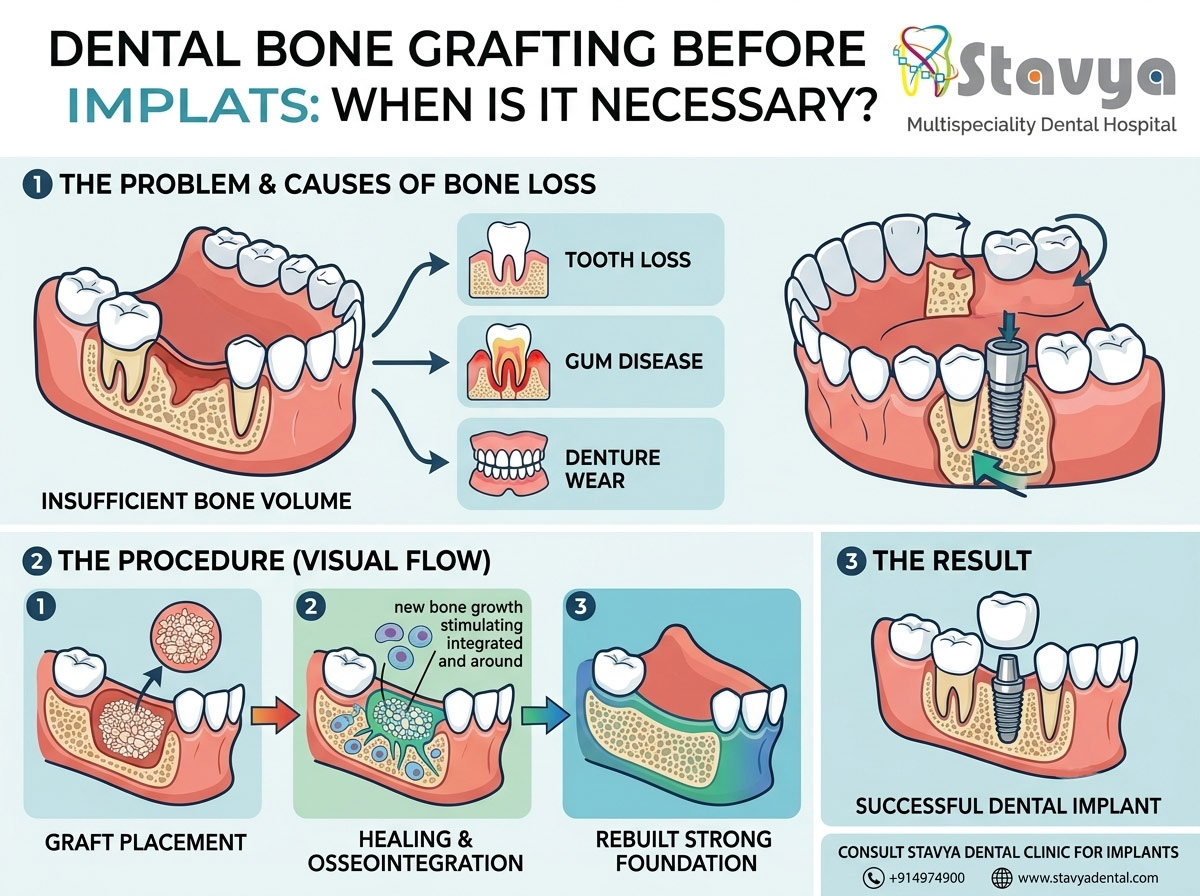
A dental implant is essentially a titanium (or zirconia) post that’s surgically placed into your jawbone, where it acts as an artificial tooth root. For this post to stay stable and support a crown, bridge, or denture, it needs to fuse securely with the surrounding bone through a process called osseointegration.
This means the success of your implant depends almost entirely on the quality and quantity of bone available at the implant site. If the jawbone is too thin, too soft, or too short in height, the implant won’t have enough support to anchor properly. Without sufficient bone, implants can fail, shift, or never integrate at all.
This is where bone grafting comes in. A bone graft rebuilds and strengthens the jaw, creating a solid foundation so your implant has the best possible chance of long-term success.
What Causes Bone Loss in the Jaw?
Many patients are surprised to learn just how quickly jawbone can deteriorate. Common causes include:
- Tooth loss: Once a tooth is extracted or falls out, the bone that once supported its root no longer receives stimulation from chewing and begins to resorb (shrink) over time. Studies show up to 25% of bone width can be lost within the first year after extraction.
- Periodontal (gum) disease: Advanced gum disease destroys the bone and connective tissue that hold teeth in place, often leaving weakened, uneven bone behind.
- Long-term denture wear: Dentures rest on the gums rather than stimulating the bone, which can accelerate bone loss over the years.
- Trauma or injury: A blow to the face or jaw can fracture or damage the bone structure.
- Infections: Untreated dental infections or abscesses can erode bone near the root of a tooth.
- Developmental or congenital conditions: Some patients naturally have thinner jawbone structure or sinus placement that limits available bone in the upper jaw.
Signs You Might Need a Bone Graft Before Implants
You typically won’t know for certain whether you need a bone graft until your dentist evaluates your jaw with X-rays or a 3D CT scan. However, some indicators that raise the likelihood include:
- Missing a tooth for several months or years without replacement
- A history of gum disease
- Previous denture use
- Visible sunken or collapsed areas along the jawline
- Upper back teeth missing (due to sinus proximity)
- Failed implants in the past
Types of Dental Bone Grafts
Not all bone grafts are the same. Your dentist will recommend the type best suited to your bone loss pattern and implant goals.
1. Socket Preservation Graft
Performed immediately after a tooth extraction, this graft fills the empty socket to prevent the surrounding bone from collapsing while it heals — ideal for patients planning an implant in the near future.
2. Ridge Augmentation
This procedure rebuilds the width or height of the jaw ridge, which is often necessary when the bone has narrowed too much to safely place an implant.
3. Sinus Lift (Sinus Augmentation)
Used specifically for the upper back jaw, a sinus lift adds bone beneath the sinus cavity when it has expanded downward due to missing molars, creating enough vertical height for implant placement.
4. Block Bone Graft
For more significant bone loss, a small block of bone (often taken from another part of the jaw) is secured to the deficient area to rebuild both width and height.
5. Guided Bone Regeneration (GBR)
A barrier membrane is placed over the graft material to direct new bone growth while keeping out soft tissue that could interfere with healing.
Bone Graft Material Options
Bone grafts can use different sources of material, and your dentist will choose based on the extent of bone loss and your overall health:
- Autograft: Bone taken from your own body (commonly the chin, jaw, or hip), offering the highest success rate since it’s your own living tissue.
- Allograft: Processed bone sourced from a human tissue bank, eliminating the need for a second surgical site.
- Xenograft: Bone derived from an animal source (typically bovine), which acts as a scaffold for your body to grow new bone.
- Synthetic (Alloplast): Lab-made biocompatible materials that stimulate natural bone regeneration.
When Is Bone Grafting Actually Necessary?
Not every implant patient needs a bone graft. Your dentist at Stavya Dental Clinic will determine necessity based on a detailed clinical exam and imaging. Generally, grafting is recommended when:
- Bone volume is insufficient to safely anchor an implant without risking nerve damage, sinus perforation, or implant failure.
- A tooth was extracted more than a few months ago without any preservation graft, allowing natural bone resorption to occur.
- You have moderate to severe gum disease that has already caused bone loss around neighboring teeth.
- The implant is planned for the upper back jaw, where sinus position often limits available bone height.
- You’ve had a previous implant fail due to inadequate bone support.
- Imaging shows the jaw ridge has become too narrow or short for standard implant dimensions.
If your bone volume is already adequate, your dentist may proceed directly to implant placement, sometimes even the same day as extraction — no grafting required.
What to Expect During the Bone Grafting Procedure
- Consultation and imaging: A 3D CT scan or panoramic X-ray maps your bone density, height, and width precisely.
- Local anesthesia: The area is numbed, and sedation options are available for anxious patients.
- Graft placement: The chosen graft material is placed at the deficient site, sometimes combined with a protective membrane.
- Closure and healing: The gum tissue is closed over the graft site, and healing begins.
- Follow-up visits: Your dentist monitors integration progress through periodic checkups and imaging.
Recovery Timeline
Healing time varies depending on the type and size of the graft:
- Minor socket preservation grafts: 3–4 months before implant placement
- Ridge augmentation or sinus lifts: 4–9 months for full bone maturation
- Block grafts: 6–9 months, sometimes longer for extensive rebuilding
During recovery, mild swelling, tenderness, and minor bleeding are normal for the first few days. Most patients return to regular activities within a week, while complete bone regeneration and integration take several months. Your dentist won’t place the implant until imaging confirms the graft has matured into strong, viable bone.
Is Bone Grafting Painful?
Bone grafting is performed under local anesthesia (with sedation options if needed), so patients typically feel little to no pain during the procedure itself. Post-operative discomfort is generally mild to moderate and manageable with prescribed pain medication, ice application, and a soft diet for a few days.
Can You Avoid Needing a Bone Graft?
While not every case is preventable, you can reduce your risk of needing extensive grafting by:
- Replacing missing teeth as soon as possible, ideally with a socket preservation graft at the time of extraction
- Treating gum disease early
- Scheduling regular dental checkups to catch bone loss before it progresses
- Avoiding prolonged denture wear without evaluating implant options
Bone Grafting Success Rates
Modern bone grafting techniques have very high success rates, generally cited between 90–95%, especially when performed by an experienced implant dentist using quality graft materials and proper surgical protocols. Factors that improve success include good oral hygiene, avoiding smoking during healing, and following post-operative care instructions closely.
Cost Considerations
The cost of bone grafting varies depending on the type of graft, the material used, and the extent of bone loss. Minor socket preservation grafts are generally more affordable, while sinus lifts and block grafts involve more extensive surgery and materials, increasing the cost. At your consultation, Stavya Dental Clinic will provide a transparent treatment plan and cost breakdown so there are no surprises before you begin.
Why Choose Stavya Dental Clinic for Bone Grafting and Implants
At Stavya Dental Clinic, we use advanced 3D imaging technology to precisely assess your bone structure before recommending any grafting procedure — ensuring you only undergo grafting when it’s truly necessary. Our experienced implant specialists use high-quality graft materials and proven surgical techniques to maximize healing and long-term implant success.
We understand that hearing you need a bone graft before implants can feel overwhelming, but this extra step is often what makes the difference between a implant that lasts a lifetime and one that fails prematurely. Our team will walk you through every stage of the process, from diagnosis to final restoration, with clear communication and personalized care.
Frequently Asked Questions
Q: Do all dental implant patients need a bone graft? No. Bone grafting is only necessary when imaging shows insufficient bone volume or density to support an implant safely.
Q: How do I know if I need a bone graft? Your dentist will determine this through a clinical exam and 3D imaging that measures your jawbone’s height, width, and density.
Q: Can I get an implant and bone graft on the same day? In some cases, minor grafting can be combined with immediate implant placement. More extensive grafts typically require a healing period before implant surgery.
Q: Will my insurance cover bone grafting? Coverage varies by provider and plan. Our team at Stavya Dental Clinic can help verify your benefits and discuss financing options.
Ready to Restore Your Smile?
If you’re missing teeth and considering dental implants, don’t let bone loss hold you back. Schedule a consultation with Stavya Dental Clinic today, and our specialists will evaluate your jawbone health, explain your options clearly, and create a personalized treatment plan to give you a strong, lasting smile.
Book Your Consultation | Learn More About Dental Implants
Related Reading
- How Long Do Dental Implants Really Last?
- Dental Implants vs. Dentures: Which Is Right for You?
- Signs You May Need a Sinus Lift for Dental Implants
- Full Mouth Dental Implants: A Complete Guide
Explore Our Technology & Services
- 3D Cone Beam CT Imaging
- Dental Implants
- Bone Grafting & Sinus Lift Procedures
- Periodontal (Gum) Treatment
.