This article is for general educational purposes only and is not a substitute for professional dental advice. Please consult a qualified dentist to evaluate your specific case.
Introduction
You wake up with a sharp twinge in one tooth. By lunchtime it has vanished, and you assume the problem has fixed itself. Then, three days later, the pain returns while you sip hot tea. If this pattern sounds familiar, you are dealing with tooth pain that comes and goes, one of the most commonly misunderstood dental symptoms.
It is tempting to relax when a toothache disappears. In reality, intermittent tooth pain is often an early warning that something is developing beneath the surface. Teeth do not heal themselves the way skin does, so a quiet tooth is not always a healthy tooth.
At Stavya Dental Clinic in Ahmedabad, we regularly meet patients who waited weeks or months because “the pain went away.” In this guide, we explain the most common causes of on-and-off tooth pain, the warning signs that need urgent attention, how dentists diagnose the problem, and what you can do to protect your smile.
Why Does Tooth Pain Come and Go?
A tooth is a living structure. Beneath the hard outer enamel and the softer dentin layer sits the pulp, a chamber of nerves and blood vessels. When something irritates or damages these layers, the nerve reacts, but not always constantly.
Pain can fluctuate for several reasons:
- Triggers come and go. Cold drinks, sweets, chewing, or pressure may only occasionally touch a sensitive spot.
- Inflammation rises and falls. A stressed nerve can calm down temporarily, then flare up again.
- Infection can drain. In some cases, pus finds a way out, relieving pressure and pain without actually curing the infection.
- Nerve damage can progress silently. When a nerve begins to die, pain may reduce, even though the underlying problem is getting worse.
The key lesson: the absence of pain does not mean the absence of a problem.
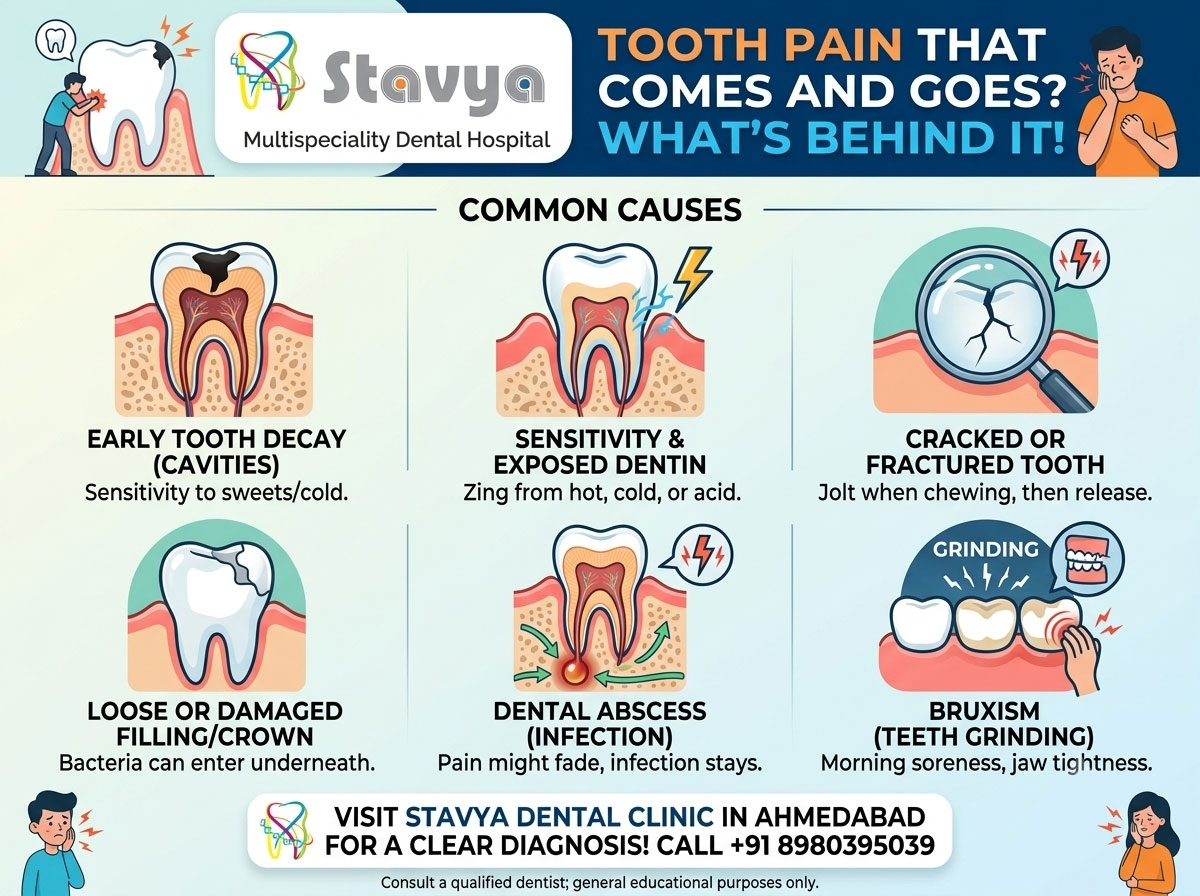
Common Causes of Tooth Pain That Comes and Goes
1. Early Tooth Decay (Cavities)
In its early stages, a cavity may cause no pain at all. As decay moves through the enamel toward the dentin, you may notice brief, sharp pain when eating sweets or drinking something cold. Because the discomfort only appears when the cavity is stimulated, it seems to come and go.
Caught early, decay can often be treated with a simple filling. Left alone, it can reach the nerve and lead to root canal treatment. To understand how early decay looks and whether it can be reversed, read our guide: Can Cavities Be Reversed? What Early Tooth Decay Looks Like.
If you need a restoration, our Fillings service can repair the tooth before the damage deepens.
2. Tooth Sensitivity and Exposed Dentin
When enamel wears thin or gums recede, the dentin underneath becomes exposed. Dentin contains microscopic channels leading to the nerve, so hot, cold, sweet, or acidic foods can trigger a quick, sharp zing.
Common contributors include:
- Aggressive brushing with a hard-bristled brush
- Acidic foods and drinks
- Gum recession caused by gum disease
- Teeth whitening products (temporary sensitivity)
- Teeth grinding
Sensitivity pain is usually short-lived and triggered by a stimulus. If it persists or worsens, it is worth having it checked, since it can mask other problems.
3. A Cracked or Fractured Tooth
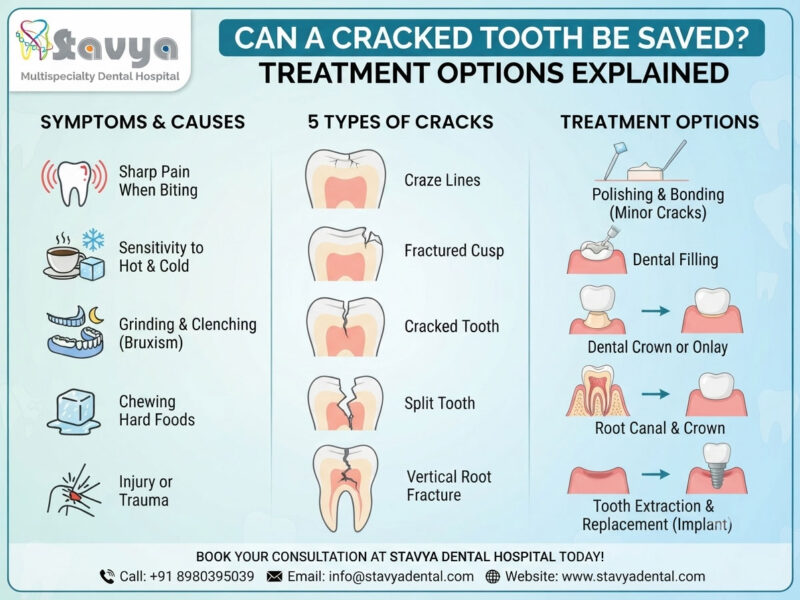
Cracked tooth syndrome is a classic cause of intermittent pain. You may feel a sudden, sharp jolt when you bite down on something, and then it disappears when you release the pressure. Cracks are often too small to see and may not show up clearly on a standard X-ray.
If the crack deepens, bacteria can enter the pulp, leading to infection. Early diagnosis improves the chances of saving the tooth. Learn more in our article: Can a Cracked Tooth Be Saved? Treatment Options Explained.
Depending on severity, treatment may include bonding, a crown, root canal therapy, or extraction. See our Crowns / Bridges service for restorative options.
4. A Loose, Leaking, or Damaged Filling or Crown
Over time, fillings can crack, shrink, or loosen. When the seal breaks, bacteria and food particles slip underneath and cause new decay. You may notice occasional pain when chewing or when something cold touches the area.
Similarly, a crown that no longer fits perfectly can leak, allowing decay to develop on the tooth underneath. If an older restoration begins to feel different, have it examined before the tooth underneath becomes damaged.
5. Reversible Pulpitis (Inflamed Nerve)
Pulpitis means inflammation of the dental pulp. In reversible pulpitis, the nerve is irritated but still healthy enough to recover if the cause (such as a cavity) is treated. Pain is typically sharp, brief, and triggered by cold or sweet stimuli, then disappears quickly once the trigger is removed.
This is the stage where treatment is simplest. A filling or other restoration often resolves the problem completely.
6. Irreversible Pulpitis and Nerve Damage
When inflammation progresses beyond the nerve’s ability to heal, the condition becomes irreversible pulpitis. Warning signs include:
- Pain that lingers for minutes after exposure to hot or cold
- Spontaneous pain that occurs without any trigger
- Throbbing pain that worsens when lying down
- Pain that wakes you at night
At this stage, the tooth usually needs root canal treatment. Our RCT / Endodontics service is designed to relieve pain and preserve the natural tooth. You can also browse related articles in our Root Canal Treatment category.
7. Tooth Infection or Abscess
A dental abscess is a pocket of pus caused by bacterial infection, usually at the tip of the root or in the gum around a tooth. Pain from an abscess is often severe and throbbing, but it can fluctuate. Sometimes an abscess drains through a small channel in the gum (sometimes called a gum boil or fistula), temporarily relieving the pressure. The pain fades, but the infection remains.
Other signs of infection include:
- Swelling in the gum, cheek, or face
- A bad taste in the mouth
- Fever or swollen glands
- A small pimple-like bump on the gum
Untreated infections can spread. Read more in our guide: What Happens If a Tooth Infection Is Left Untreated?. If you have facial swelling, fever, or difficulty swallowing or breathing, seek urgent care immediately.
8. Gum Disease and Periodontal Problems
Gum disease does not always hurt, but advanced stages can cause on-and-off pain, especially when food becomes trapped in deep gum pockets or when an abscess forms in the gum. Other signs include bleeding gums, bad breath, receding gums, and teeth that feel loose.
Learn more about how deep gum pockets develop and are treated: What Are Periodontal Pockets and How Are They Treated? and Why Are My Teeth Becoming Loose? Causes You Should Know.
Our Periodontics and Laser Treatment services offer modern options for managing gum problems.
9. Teeth Grinding (Bruxism) and Clenching
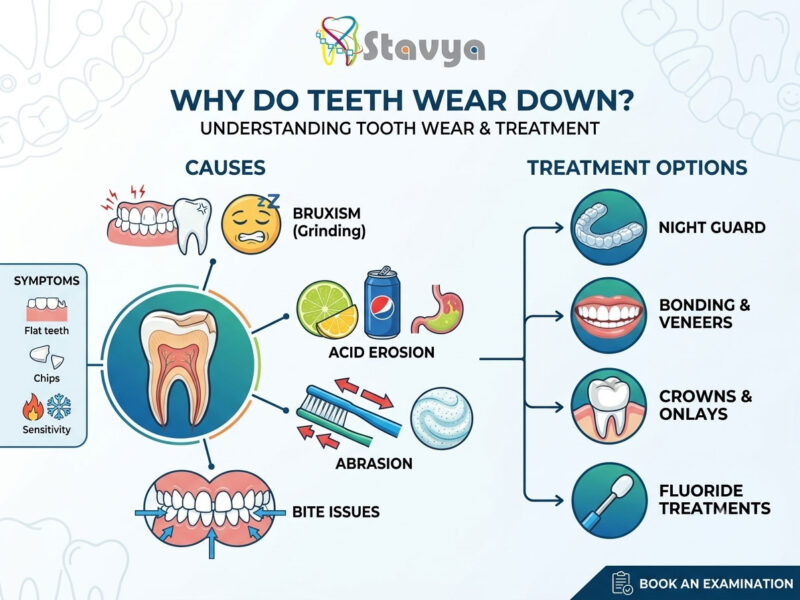
Many people grind or clench their teeth during sleep or stress without realizing it. Over time, this can cause worn enamel, small cracks, jaw muscle fatigue, and tooth sensitivity. The pain is often worse in the morning and may ease during the day.
If you often wake up with sore teeth or a tight jaw, our article Why Do My Teeth Hurt When I Wake Up? Possible Causes may help you understand the connection.
10. Wisdom Tooth Problems
Partially erupted or impacted wisdom teeth can cause pain that flares up and settles repeatedly. Food and bacteria trapped under the gum flap can cause a painful infection called pericoronitis. The pain may come in waves, sometimes with swelling, jaw stiffness, or a bad taste.
See the warning signs in our guide: 7 Signs Your Wisdom Tooth Needs Immediate Removal. Our Extraction And Disimpaction service handles problem wisdom teeth safely.
11. Sinus Problems Mimicking Tooth Pain
The roots of your upper back teeth sit very close to the maxillary sinuses. When the sinuses are inflamed or infected, pressure can feel like an ache in several upper teeth at once. This pain often changes with head position and may come with nasal congestion or facial pressure.
Because the pain is referred, the teeth themselves may be perfectly healthy. A dental exam and imaging help confirm whether the source is dental or sinus-related.
12. Pain After Recent Dental Work
Some sensitivity after a filling, crown, or deep cleaning is normal and usually settles within a few weeks. If a restoration sits slightly too high, it can cause pain on biting that comes and goes. A quick bite adjustment often fixes it. Contact your dentist if the pain persists beyond a couple of weeks or worsens.
13. Less Common Causes
Occasionally, intermittent facial or tooth pain has a non-dental origin, such as:
- TMJ disorders affecting the jaw joint and surrounding muscles
- Trigeminal neuralgia, a nerve condition causing sudden, electric-shock-like facial pain
- Referred pain from the heart, particularly jaw pain accompanied by chest discomfort, shortness of breath, or sweating, which requires emergency medical care
Your dentist can rule out dental causes and refer you to the right specialist when necessary.
How to Tell What Your Pain Is Telling You
The pattern of your pain can offer clues, though only a dentist can give a diagnosis.
| Pain Pattern | Possible Cause |
|---|---|
| Brief, sharp pain with cold or sweets | Early decay, sensitivity, reversible pulpitis |
| Sharp pain on biting that stops on release | Cracked tooth, high filling |
| Lingering pain after hot or cold | Irreversible pulpitis |
| Throbbing, worse at night | Nerve inflammation or abscess |
| Pain with swelling or a gum bump | Infection or abscess |
| Dull ache in several upper teeth | Sinus pressure |
| Morning soreness and tight jaw | Bruxism or clenching |
| Pain around the back molar area | Wisdom tooth or pericoronitis |
Warning Signs That Need Urgent Attention
See a dentist promptly if your tooth pain comes with any of the following:
- Swelling of the face, jaw, or gums
- Fever or general feeling of being unwell
- A pimple-like bump on the gum
- Pain that lasts longer than a day or two
- Severe throbbing pain that disturbs sleep
- Difficulty opening your mouth, swallowing, or breathing (seek emergency care immediately)
Even if none of these apply, do not wait simply because the pain has gone away. An evaluation while the problem is small is nearly always simpler, quicker, and more affordable than treatment after it has progressed.
How Dentists Diagnose Intermittent Tooth Pain
Because the pain comes and goes, finding the source requires careful investigation. A thorough evaluation typically includes:
- A detailed history. When does the pain occur? What triggers it? How long does it last? What relieves it?
- A clinical examination. The dentist checks teeth, gums, fillings, and bite for visible problems.
- Percussion and bite tests. Gentle tapping or biting tests can identify cracked or inflamed teeth.
- Temperature and vitality tests. These help evaluate how the nerve responds.
- Dental imaging. X-rays reveal decay between teeth, bone changes, and infection around the root. For complex cases, 3D imaging may be recommended.
At Stavya Dental Clinic, our Radiology services support accurate diagnosis, helping us find the true source of pain rather than guess.
Treatment Options for Tooth Pain That Comes and Goes
Treatment depends entirely on the cause.
| Cause | Typical Treatment |
|---|---|
| Early cavity | Dental filling |
| Sensitivity | Desensitizing treatment, fluoride, improved brushing technique |
| Cracked tooth | Bonding, crown, root canal, or extraction in severe cases |
| Damaged filling or crown | Replacement or repair |
| Inflamed or infected nerve | Root canal treatment |
| Abscess | Drainage, root canal, antibiotics when indicated, or extraction |
| Gum disease | Deep cleaning, laser therapy, gum treatment |
| Bruxism | Night guard, stress management |
| Wisdom tooth problems | Cleaning, medication, or removal |
| Missing or non-restorable tooth | Dental implants, crowns, or bridges |
If a tooth cannot be saved, replacement options such as Dental Implants or Crowns / Bridges can restore function and appearance. For retreatment of previously treated teeth, see Why Some Root Canals Need Retreatment.
What You Can Do at Home While You Wait for Your Appointment
Home care is not a substitute for treatment, but these steps may offer temporary comfort:
- Rinse gently with warm salt water to keep the area clean.
- Avoid very hot, cold, or sugary foods that trigger the pain.
- Chew on the opposite side to avoid pressure on the sore tooth.
- Use a soft-bristled brush and gentle technique around the area.
- Take over-the-counter pain relief as directed on the label, if suitable for you.
- Avoid placing aspirin directly on the gum, which can irritate tissue.
- Keep your head slightly elevated when sleeping if throbbing is worse at night.
These measures only mask symptoms. The underlying cause still needs professional care.
How to Prevent Recurring Tooth Pain
Most causes of intermittent tooth pain are preventable with consistent habits:
- Brush twice daily with fluoride toothpaste, using a soft brush.
- Clean between your teeth daily with floss or interdental brushes.
- Limit sugary and acidic foods and drinks, especially between meals.
- Do not use your teeth as tools to open packages or bite hard objects.
- Wear a night guard if you grind your teeth.
- Replace old restorations when your dentist recommends it.
- Visit your dentist regularly for examinations and professional cleaning. See our guide: How Often Should You Get a Professional Dental Cleaning?
- Consider preventive treatments such as sealants for children and adults. Learn more: Dental Sealants: The Ultimate Guide to Cavity Protection.
For younger patients, our Pedodontics service provides gentle, child-friendly dental care.
Why Choose Stavya Dental Clinic in Ahmedabad?
When you visit Stavya Dental Clinic, you get a careful evaluation that looks for the real cause of your pain, rather than a quick fix that only hides the symptom. Our team offers a full range of treatments under one roof, including Dental Implants, RCT / Endodontics, Periodontics, Laser Treatment, Aesthetic Dentistry, Orthodontics, and more. You can explore all of our services or browse more articles in our Dental Treatment, Teeth, and Dentistry blog categories.
📞 Call: +91 8980395039 | 📧 Email: info@stavyadental.com | 🌐 stavyadental.com
Frequently Asked Questions
Q1. Why does my tooth hurt sometimes and then stop? Intermittent pain usually means a trigger, such as cold, sweets, or chewing, is only occasionally reaching a damaged or sensitive area. It can also mean inflammation is rising and falling, or that an infection is draining. Either way, a dental exam is the best way to find the cause.
Q2. Is it safe to ignore tooth pain that goes away on its own? No. Pain that disappears does not mean the problem has healed. A cavity, crack, or infected nerve can quietly progress. Early treatment is usually simpler and less costly.
Q3. Can a tooth hurt and then stop because the nerve has died? Yes. When a nerve dies, pain may reduce or stop, but the infection can continue to develop around the root. This is a common reason patients are surprised by sudden swelling later.
Q4. How long should I wait before seeing a dentist for tooth pain? If pain returns more than once, lingers after hot or cold, wakes you at night, or comes with swelling, book an appointment soon. Facial swelling, fever, or trouble swallowing or breathing needs urgent attention.
Q5. Can stress cause tooth pain? Indirectly, yes. Stress often leads to clenching or grinding, which can cause tooth sensitivity, small cracks, and jaw soreness.
Q6. Can sinus problems cause tooth pain? Yes. Inflamed sinuses can press on the roots of the upper back teeth and cause an ache that feels like a toothache, even when the teeth are healthy.
Q7. Will I need a root canal if my tooth hurts on and off? Not necessarily. If the cause is early decay or sensitivity, a filling or simple treatment may be enough. Root canal treatment is usually needed when the nerve is irreversibly inflamed or infected. Only an examination can tell.
Final Thoughts
Tooth pain that comes and goes is your body’s way of tapping you on the shoulder. Whether the cause is a small cavity, a hairline crack, a worn filling, or a developing infection, the best time to act is before the pain becomes constant. A short visit now can save you from more complex, expensive, and uncomfortable treatment later.
If your tooth has been aching on and off, do not wait for it to get worse. Book a consultation with Stavya Dental Clinic in Ahmedabad and let us find out exactly what is going on.
Stavya Dental Clinic provides comprehensive dental care in Ahmedabad, from preventive treatment and root canals to dental implants and laser dentistry. Visit stavyadental.com or call +91 8980395039 to schedule your appointment.