Most of us book a dental appointment only when something hurts. But by the time a tooth aches, a cavity has usually reached the nerve, or gum disease has already damaged the bone. A comprehensive dental checkup is designed to catch problems earlier, when treatment is simpler, shorter and more affordable.
Many people skip checkups because they don’t know what to expect. Will it hurt? How long does it take? What is the dentist actually looking for? This guide walks you through every step of a comprehensive dental checkup, so you can walk into your next visit at Stavya Dental Clinic in Ahmedabad feeling informed and relaxed.
What Is a Comprehensive Dental Checkup?
A comprehensive dental checkup is a full evaluation of your teeth, gums, jaw joints, bite, tongue, and the soft tissues of your mouth and neck. It is more thorough than a quick look at one problem tooth.
It is usually done at your first visit to a new dentist, and then updated regularly. A routine follow-up visit is shorter, but it builds on the same foundation. The goal is to build a complete picture of your oral health, so that any change can be spotted and treated early.
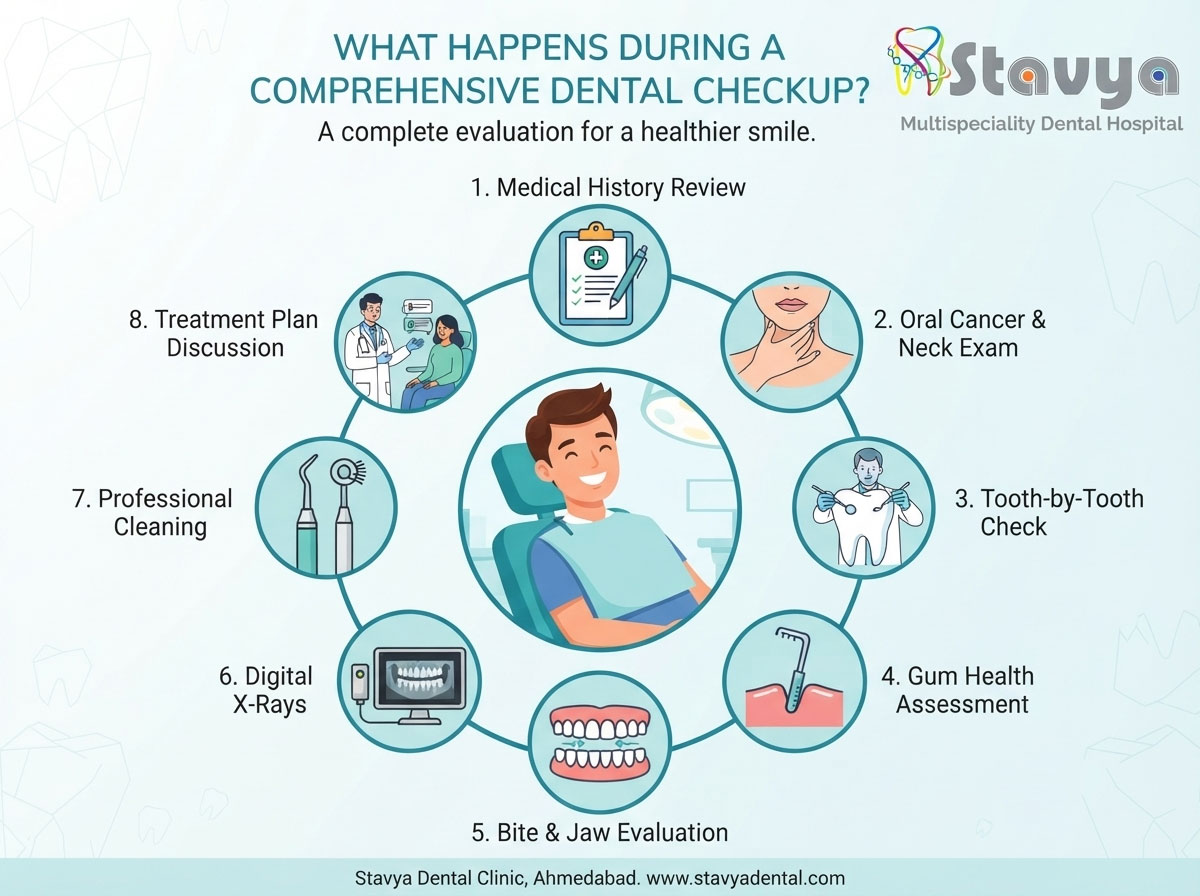
A typical checkup includes:
- A review of your medical and dental history
- A head, neck and oral cancer screening
- An examination of every tooth
- A gum and bone health assessment
- A bite and jaw joint evaluation
- Digital X-rays or other imaging when needed
- A professional cleaning
- A discussion of findings and a personalised care plan
Let’s look at each step in detail.
Step 1: Reviewing Your Medical and Dental History
Your visit starts with a conversation. The dentist or team member will ask about:
- Your general health, ongoing conditions and current medicines
- Allergies, including reactions to anaesthetics or latex
- Previous dental treatments, such as fillings, root canals or braces
- Any current pain, sensitivity, bleeding gums or bad breath
- Habits like smoking, tobacco chewing, teeth grinding or nail biting
- How often you brush, floss and eat sugary foods
This isn’t small talk. Conditions like diabetes, high blood pressure, pregnancy and certain medicines can affect your teeth, your gums and how you heal. Being honest helps your dentist tailor the visit and choose safe treatment options.
Step 2: Head, Neck and Oral Cancer Screening
Before looking at your teeth, a good dentist checks the tissues around them. This includes your lips, cheeks, tongue, floor of the mouth, palate, throat and the lymph nodes in your neck.
The dentist looks and feels for white or red patches, non-healing ulcers, lumps, or changes in colour and texture. This quick, painless screening is especially important if you smoke or use tobacco, because early detection makes a major difference in outcomes for oral conditions.
Any suspicious area is documented, monitored, or referred for further testing. This is not meant to alarm you. Most changes turn out to be harmless, but a checkup is the safest way to know.
Step 3: Examining Every Tooth
Next, the dentist examines each tooth, looking closely at all its surfaces. Using a small mirror and a gentle probe, they check for:
- Cavities (tooth decay): soft, discoloured or sticky spots
- Cracks and chips: sometimes too fine for you to notice
- Worn enamel: often linked to grinding or acidic foods
- Old fillings, crowns or bridges: checking for leaks, wear or loose margins
- Sensitivity: teeth that react to hot, cold or sweet foods
Small cavities are often painless. Finding one at this stage may mean a simple tooth-coloured filling instead of a root canal later. If decay has already reached the nerve, RCT / endodontic treatment can save the tooth. Our post on how long a cavity can actually wait explains why acting early matters.
Step 4: Checking Your Gums and Supporting Bone
Healthy teeth need healthy gums. During this step, your dentist measures the small space between each tooth and the gum, called a pocket, using a fine, calibrated probe. Shallow pockets generally suggest healthy gums. Deeper pockets, bleeding, swelling or receding gums can point to gum disease.
Gum disease is common and often painless in its early stage. Warning signs include bleeding when you brush, persistent bad breath, gums that look red or puffy, and teeth that feel loose. Caught early, gum inflammation can often be reversed with a professional cleaning and better home care. Advanced cases may need specialist periodontal treatment.
If bad breath is your main worry, read why your breath may smell bad even after brushing.
Step 5: Evaluating Your Bite and Jaw Joints
Your dentist also studies how your upper and lower teeth fit together, and how your jaw moves. They may ask you to open, close and slide your jaw while feeling the joints in front of your ears.
They are looking for:
- Crowded, rotated or gapped teeth
- An uneven bite, such as an overbite, underbite or crossbite
- Clicking, popping or tenderness in the jaw joint
- Signs of teeth grinding, such as flattened or chipped edges
A poor bite can cause uneven wear, jaw pain and headaches. If your jaw hurts when you chew, this article on common dental causes of jaw pain may help. If you grind your teeth at night, you might benefit from a night guard.
When the bite or alignment is the issue, options range from traditional braces to Invisalign and invisible braces. You can learn more about our orthodontics services or browse our Orthodontic blog category.
Step 6: Digital X-Rays and Diagnostic Imaging
Much of what can go wrong in your mouth happens where no one can see: between teeth, under old fillings, below the gum line and inside the bone. That is why X-rays are often part of a comprehensive checkup, particularly at a first visit or if you haven’t had imaging in a while.
Your dentist may recommend:
- Bitewing X-rays to detect decay between the back teeth
- Periapical X-rays to view the full tooth, root and surrounding bone
- Panoramic X-rays to see all teeth, both jaws, and sinuses in a single image
Digital radiology uses much lower radiation than older film X-rays, and images appear on screen within seconds so the dentist can explain them to you. At Stavya Dental Clinic, we also use non-invasive intraoral scanners in suitable cases, which means no messy impression putty for you to bite into.
X-rays are prescribed only when they are needed. Your dentist will decide based on your age, risk of decay, symptoms and history. If you are pregnant, tell the team before any imaging.
Step 7: Professional Cleaning (Scaling and Polishing)
Even careful brushers miss spots. Over time, plaque hardens into tartar (calculus), which cannot be removed at home. It irritates gums, traps stains and contributes to bad breath.
During a professional cleaning, the hygienist or dentist:
- Removes plaque and tartar above and just below the gum line, using ultrasonic instruments and hand tools
- Polishes your teeth to remove surface stains and smooth the enamel
- Flosses between teeth and rinses away debris
Cleaning is generally comfortable. Some sensitivity or slight gum tenderness afterward is common and usually settles quickly. If you want to brighten your smile further, your dentist can discuss aesthetic dentistry options.
Step 8: Fluoride and Preventive Care
Depending on your age and risk of decay, your dentist may apply a fluoride varnish or recommend sealants for deep grooves in back teeth. Fluoride strengthens enamel and helps early decay re-harden before it becomes a cavity.
You will also get practical advice on:
- Brushing technique and the right toothbrush
- Flossing or using interdental brushes
- Diet, especially frequent snacking and sugary or acidic drinks
- Managing dry mouth, which raises decay risk (see dry mouth and tooth decay)
Step 9: Discussing Findings and Your Treatment Plan
The final step is arguably the most valuable. Your dentist explains what they found in plain language, shows you X-rays or photographs, and answers your questions.
If everything looks healthy, you’ll receive tips to keep it that way and a recommended date for your next visit. If something needs attention, a good dentist will lay out:
- What the problem is and why it matters
- Your treatment options, with pros, cons and expected timelines
- Which issues are urgent and which can wait or be monitored
- What each option is likely to involve, so there are no surprises
Depending on the findings, follow-up care may include:
- Fillings for cavities
- Crowns and bridges for heavily damaged or missing teeth (for chips, see bonding vs crown)
- Dental implants to replace missing teeth
- Removable partial and complete dentures
- Extraction and disimpaction for teeth that cannot be saved or impacted wisdom teeth
- Laser treatment for suitable gum and soft-tissue procedures
Ask for a written plan if you’d like one, and never feel pressured to decide on the spot.
Is a Child’s Checkup Different?
Yes. Children’s checkups also look at how the jaws and permanent teeth are developing, and they focus on making the experience friendly and fear-free. Our pedodontics team handles children’s dental care, and early alignment issues are covered in our guide to orthodontic warning signs parents should watch for.
How Often Should You Have a Comprehensive Checkup?
Many dentists recommend a checkup and cleaning every six months, but this isn’t one-size-fits-all. You may need visits more often if you:
- Have gum disease or a history of it
- Get cavities frequently
- Smoke or use tobacco
- Have diabetes or a weakened immune system
- Wear braces, aligners, implants or dentures
If your mouth is very healthy and low risk, your dentist may suggest longer intervals. Ask what schedule suits you.
Also don’t wait for your next scheduled visit if you notice bleeding gums, persistent pain, swelling, a loose tooth or an ulcer that won’t heal in about two weeks. Read more about hidden signs of oral health problems most people ignore.
How to Prepare for Your Appointment
A few simple steps make your visit smoother:
- Bring a list of your medicines and any previous dental records or X-rays
- Brush and floss as usual before you arrive
- Write down any symptoms or questions, such as sensitivity, bad breath or cosmetic concerns
- Mention any anxiety. A good team will slow down and explain each step
- Arrive a few minutes early to complete paperwork
Why Choose Stavya Dental Clinic for Your Checkup?
At Stavya Dental Clinic, we believe a checkup should leave you informed, not intimidated. Here’s what patients can expect:
- Multi-specialty care under one roof, from checkups and cleaning to orthodontics, implants and root canals
- Clear explanations in plain language, with images to show you what we see
- Modern diagnostics, including low-radiation digital imaging
- A conservative approach that focuses on prevention and treats only what is needed
- A comfortable, child-friendly environment for the whole family
Not sure how to pick a dentist? Our complete guide to choosing the right dentist in Ahmedabad lists what to look for. If you live or work nearby, see our pages for a dental clinic near Satellite, near Vastrapur and near Shivranjani.
Frequently Asked Questions
Does a dental checkup hurt?
Usually not. Most of it involves looking, gentle probing and cleaning. If you have sensitive teeth or dental anxiety, tell your dentist so they can make you comfortable.
How long does a comprehensive checkup take?
Typically around 45 to 60 minutes for a first visit including imaging and cleaning. Follow-up visits are often shorter.
Do I need X-rays every time?
Not necessarily. Your dentist decides based on your risk, symptoms and when you last had imaging.
Can I eat before my appointment?
Yes. Just brush and floss beforehand, and let your dentist know if you have any medical conditions that affect eating or medication schedules.
Is a dental checkup necessary if my teeth don’t hurt?
Yes. Cavities, gum disease and oral changes are often painless in the early stages. Regular checkups are how they get caught early.
What if the dentist finds a problem?
You’ll receive an explanation and a set of options. Many early problems can be treated with simple, minimally invasive care.
Final Thoughts
A comprehensive dental checkup is one of the simplest, most effective things you can do for your health. It takes about an hour, it’s generally comfortable, and it can prevent pain, save teeth and reduce the cost of future treatment.
Book your visit at Stavya Dental Clinic today, and take the first step toward a healthier smile.
Stavya Dental Clinic
Upper floor, Tirthjal Complex, Opp. ICICI Bank, 132 ft. Ring Road, Way to Shivranjani Cross Road, Satellite, Ahmedabad – 380015
📞 Call / WhatsApp: +91 8980395039
🌐 www.stavyadental.com