Chewing is something most people never think about — until it hurts. A sharp twinge when you bite into an apple, a dull ache that builds up by the end of a meal, or a clicking sound every time you open your mouth wide: these aren’t things to brush off as “just getting older” or “sleeping wrong.” Jaw pain while chewing is almost always your body telling you something specific is wrong, and in most cases, it’s coming from a dental or jaw-joint problem that has a clear diagnosis and a clear fix.
At Stavya Dental Clinic, jaw pain is one of the more common complaints we see walk through the door — and one of the most commonly misdiagnosed by patients themselves before they come in. People assume it’s a sinus issue, a headache, or “just stress,” when the real cause is often sitting inside the mouth. This guide walks through the most frequent dental causes of jaw pain while chewing, how to tell them apart, and when it’s time to get it checked instead of waiting it out.
1. TMJ Disorder (Temporomandibular Joint Dysfunction)
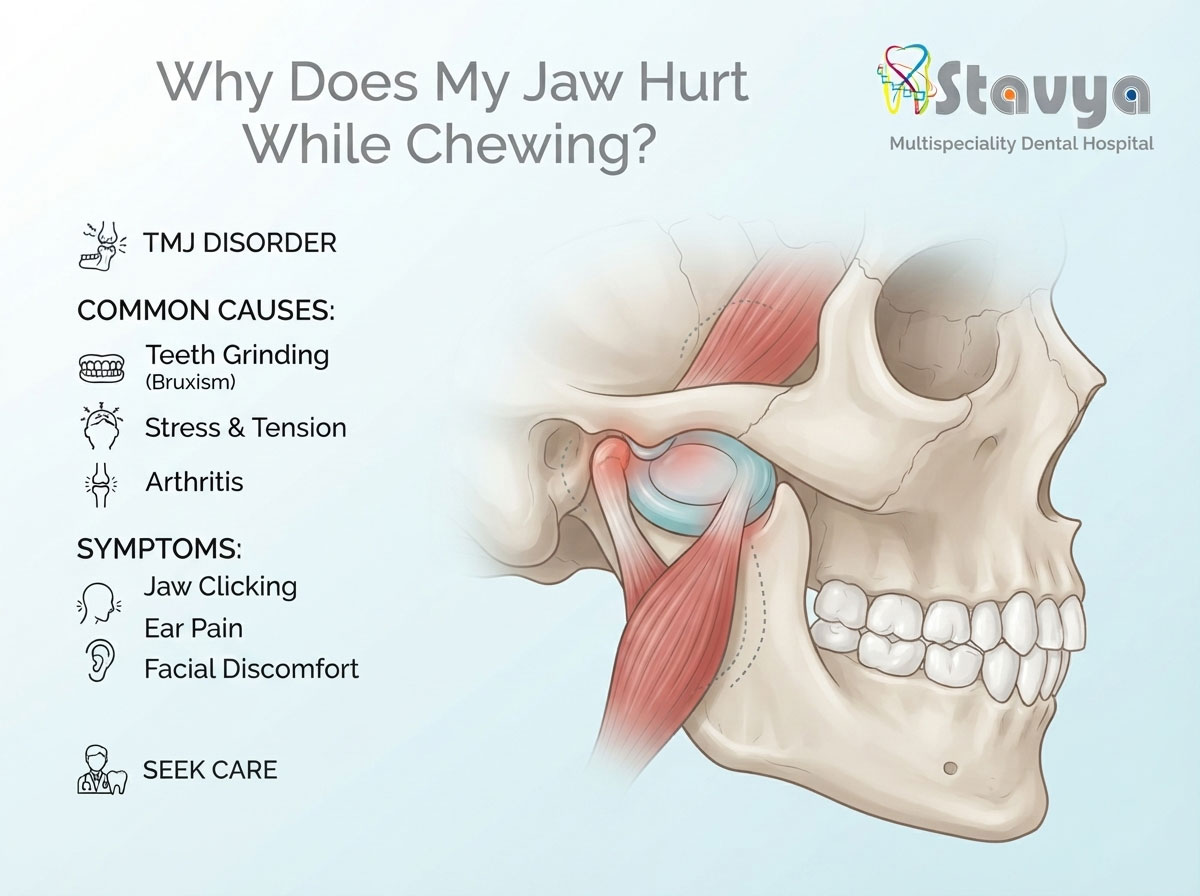
The temporomandibular joint connects your jawbone to your skull, and it’s one of the most-used joints in your body — you engage it every time you talk, chew, yawn, or swallow. When this joint or the muscles around it become inflamed, misaligned, or overworked, the result is a condition called TMJ disorder (TMD).
Common signs:
- Pain or tenderness near the ear when chewing
- A clicking, popping, or grinding sound when opening the mouth
- Jaw locking or getting “stuck” open or closed
- Pain that radiates to the face, neck, or shoulders
TMJ disorder can be triggered by stress-related jaw clenching, an uneven bite, arthritis, or even a previous jaw injury. It’s rarely dangerous, but it’s uncomfortable enough that most patients seek relief fairly quickly — and it tends to get worse the longer it’s left untreated, especially if grinding is part of the cause. If nighttime clenching is a factor for you, it’s worth reading our post on teeth grinding at night and when a night guard makes sense, since TMD and bruxism frequently show up together.
2. Bruxism (Teeth Grinding or Clenching)
Grinding or clenching your teeth — often during sleep, sometimes unconsciously during the day — puts enormous repetitive strain on your jaw muscles and joint. Over months or years, this can lead to chewing pain, morning jaw stiffness, headaches, and visibly worn-down teeth.
Common signs:
- Jaw soreness that’s worst first thing in the morning
- Flattened or chipped tooth edges
- Increased tooth sensitivity
- A partner mentioning grinding sounds at night
Bruxism is frequently linked to stress, misaligned bites, or sleep disorders. A custom night guard is usually the first line of defense, since it protects both the teeth and the jaw joint from the physical load of grinding. If you suspect this is your cause, our detailed breakdown on teeth grinding and night guards covers what to watch for and how treatment typically works.
3. Cracked or Fractured Tooth
A crack in a tooth — sometimes too small to see with the naked eye — can cause sharp, specific pain the moment you bite down, especially on that particular tooth. Unlike TMJ pain, which tends to feel more generalized around the jaw, a cracked tooth usually hurts in one distinct spot and eases up as soon as pressure is released.
Common signs:
- Sudden, sharp pain when chewing on one specific tooth
- Pain that comes and goes rather than staying constant
- Sensitivity to hot, cold, or sweet foods
- Occasional swelling of the gum near the affected tooth
Left untreated, a cracked tooth can allow bacteria to reach the inner pulp, leading to infection or the need for a root canal. Depending on the severity, treatment can range from a simple filling to a crown or, in more advanced cases, root canal therapy. Catching it early almost always means a simpler, less expensive fix — our post on how long a cavity can wait before it becomes a bigger problem applies to cracks too: the longer you wait, the more invasive the treatment tends to get.
4. Tooth Decay and Deep Cavities
A cavity that’s progressed close to the nerve can cause real pain during chewing, particularly when biting down forces pressure into the damaged area. This is different from mild sensitivity — deep decay tends to produce a throbbing or sharp pain that’s triggered specifically by pressure or temperature.
Common signs:
- Pain when biting down on a specific tooth
- Visible dark spots or holes in the tooth
- Lingering sensitivity to hot or cold
- Bad breath or an unpleasant taste near the affected area
Cavities don’t heal on their own, and pain during chewing is usually a sign that decay has already reached a significant depth. Depending on how far it’s progressed, treatment might involve a filling, a crown, or root canal treatment if the nerve is involved. For more on the risks of delaying treatment, see our article on how long a cavity can actually wait.
5. Impacted or Erupting Wisdom Teeth
Wisdom teeth that are impacted, growing in at an angle, or only partially erupted can cause significant jaw pain, especially when chewing puts pressure on the surrounding gum and bone. This is one of the more common causes of jaw pain in younger adults, typically between the ages of 17 and 25.
Common signs:
- Pain toward the back of the jaw, often on one side
- Swollen or tender gums near the back molars
- Difficulty opening the mouth fully
- Jaw stiffness that worsens over a few days
If a wisdom tooth is impacted or repeatedly causing infection, extraction is usually recommended before the problem escalates into a more serious infection. You can learn more about the process on our extraction and disimpaction service page.
6. Gum Disease and Dental Infections
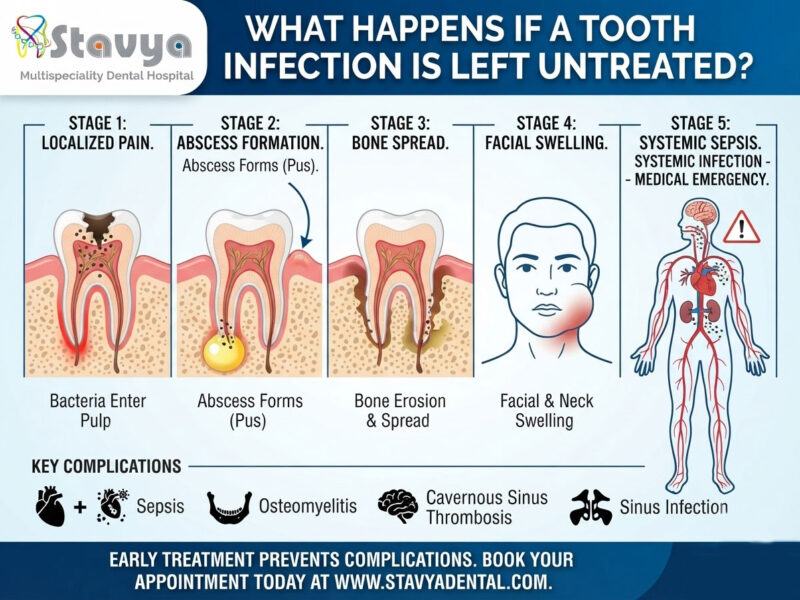
Advanced gum disease (periodontitis) or a dental abscess can cause pain that intensifies with chewing pressure, along with swelling, tenderness, and sometimes a foul taste from pus drainage. Unlike a simple cavity, an infection can spread if left untreated and, in some cases, becomes a genuine dental emergency.
Common signs:
- Swollen, red, or bleeding gums
- A visible bump or “pimple” on the gum
- Pain that throbs and worsens with pressure
- Fever or facial swelling in severe cases
Gum-related jaw pain typically requires treatment from a periodontist, ranging from a deep cleaning to more advanced procedures depending on severity. Explore our periodontics services for more on how gum disease is treated. If you’re also experiencing swelling, fever, or pain that’s escalating quickly, it’s worth reviewing our guide on dental emergencies and when you shouldn’t wait.
7. Misaligned Bite (Malocclusion)
When your upper and lower teeth don’t meet correctly, certain teeth or areas of the jaw absorb more pressure than they’re designed to during chewing. Over time, this uneven load can cause chronic jaw soreness, muscle fatigue, and even accelerate TMJ problems.
Common signs:
- Jaw fatigue that builds throughout the day
- Uneven wear patterns on certain teeth
- Difficulty finding a “comfortable” bite position
- Jaw pain that improves with rest and returns with chewing
Malocclusion is typically corrected with orthodontic treatment. Depending on the case, options range from traditional approaches to more discreet solutions like Invisalign or invisible braces. A full evaluation through our orthodontics service can determine whether bite correction is the underlying cause of your jaw pain.
8. Sinus Issues (Referred Pain)
Not every case of jaw pain while chewing originates in the jaw itself. The upper back teeth sit close to the sinus cavities, so sinus infections or inflammation can sometimes produce pain that feels like it’s coming from the teeth or jaw, especially when chewing or applying pressure.
Common signs:
- Pain concentrated in the upper back teeth or jaw
- Pressure or pain that worsens when bending forward
- Nasal congestion or facial pressure alongside the jaw pain
- No visible dental cause on examination
If a dental exam and X-ray don’t show a tooth-related cause, sinus involvement is worth ruling out with a physician, since the two conditions can feel very similar from the patient’s side.
9. Arthritis Affecting the Jaw Joint
Osteoarthritis or rheumatoid arthritis can affect the temporomandibular joint just as they affect other joints in the body, leading to stiffness, pain, and reduced range of motion, particularly noticeable during chewing.
Common signs:
- Jaw stiffness that’s worse in the morning
- Gradual, ongoing pain rather than sudden onset
- Reduced ability to open the mouth wide
- Pain that correlates with arthritis symptoms elsewhere in the body
This type of jaw pain is usually managed jointly between your dentist and physician, often combining bite-guard therapy with broader arthritis management.
When to See a Dentist for Jaw Pain
A little jaw soreness after a particularly chewy meal usually isn’t cause for concern. But you should book an appointment if you notice:
- Pain that lasts more than a few days
- Pain that’s sharp, localized, or getting worse
- Swelling, fever, or visible signs of infection
- Jaw locking or significant difficulty opening your mouth
- Pain that’s affecting your ability to eat normally
A proper diagnosis usually starts with a clinical exam and, where needed, imaging through dental radiology to identify what’s happening below the surface — whether that’s a hidden crack, an impacted tooth, or bone-level changes around the jaw joint.
How Stavya Dental Clinic Diagnoses and Treats Jaw Pain
At Stavya Dental Clinic, jaw pain is never treated as a one-size-fits-all problem. Diagnosis typically starts with understanding when the pain occurs, what it feels like, and whether it’s localized to one tooth or spread across the jaw. From there, we use clinical examination and imaging to pinpoint the exact cause — whether that means:
- A root canal for a cracked or infected tooth
- A crown or bridge to restore a damaged tooth’s structure
- Periodontal treatment for gum-related infection
- Extraction for an impacted wisdom tooth
- A custom night guard for bruxism-related TMJ strain
- Orthodontic correction for bite misalignment
Because so many of these causes share overlapping symptoms, the most important step is simply not guessing — a short consultation is usually enough to rule out the serious causes and get you on a clear treatment path.
Frequently Asked Questions
Is jaw pain while chewing always dental? Not always — sinus issues and arthritis can also cause it — but a dental or TMJ-related cause is by far the most common source, so a dental exam is usually the right first step.
Can stress cause jaw pain? Yes. Stress is one of the leading triggers of jaw clenching and teeth grinding, both of which strain the jaw joint and muscles significantly over time.
Will jaw pain go away on its own? Mild, occasional soreness often resolves with rest. Pain that’s sharp, recurring, or worsening usually indicates an underlying issue — like a crack, infection, or TMJ disorder — that needs to be treated rather than waited out.
How is TMJ disorder diagnosed? Through a combination of clinical examination, a review of your bite and jaw movement, and imaging when needed to rule out structural issues.
Final Thoughts
Jaw pain while chewing is your body’s way of flagging a problem — whether that’s a hairline crack in a tooth, an overworked jaw joint, or an infection that needs attention before it spreads. The good news is that nearly every cause on this list is treatable, and most get easier to manage the earlier they’re caught.
If chewing has started to hurt and you’re not sure why, Stavya Dental Clinic can help you find the exact cause and the right treatment — rather than leaving you to guess. Book a consultation or explore our full range of services to learn more.
Related reading from the Stavya Dental Clinic blog:
- Teeth Grinding at Night: When Should You Consider a Night Guard?
- Dental Emergency or Can It Wait? 10 Situations That Need Urgent Care
- How Long Can a Cavity Actually Wait Before It Becomes a Bigger Problem?
- Dental Care for Seniors: Maintaining Natural Teeth and Gum Health in Your 60s and Beyond
Category: Dental Clinic | Tags: jaw pain, TMJ disorder, bruxism, cracked tooth, dental pain, chewing pain