Losing a tooth is stressful enough without also wondering whether your jaw can support a replacement. At Stavya Dental Clinic, one of the questions we hear most often from patients considering dental implants is simple but important: how much bone do I actually need to get one placed?
The short answer is that dentists work with specific height, width, and density benchmarks — but even if you fall short of them today, there are proven ways to move forward. This guide walks through exactly what those numbers mean, what causes low bone volume in the first place, and what your options look like if a scan shows you don’t quite qualify yet.
Why Bone Volume Matters for a Dental Implant
Unlike a crown or a bridge that sits on top of existing structures, a dental implant is a titanium (or zirconia) post that is surgically placed into the jawbone. Over the following weeks, the bone fuses around the implant in a process called osseointegration — and that fusion is what allows the implant to handle the same biting forces as a natural tooth root.
If the bone at the implant site is too short, too narrow, or too soft, there simply isn’t enough surrounding structure for the implant to anchor into securely. This is why every implant case at our clinic starts with a detailed evaluation of the jawbone, not just the gum and tooth above it — the same principle covered in our guide on what happens during a comprehensive dental checkup.
The General Bone Requirements for Implants
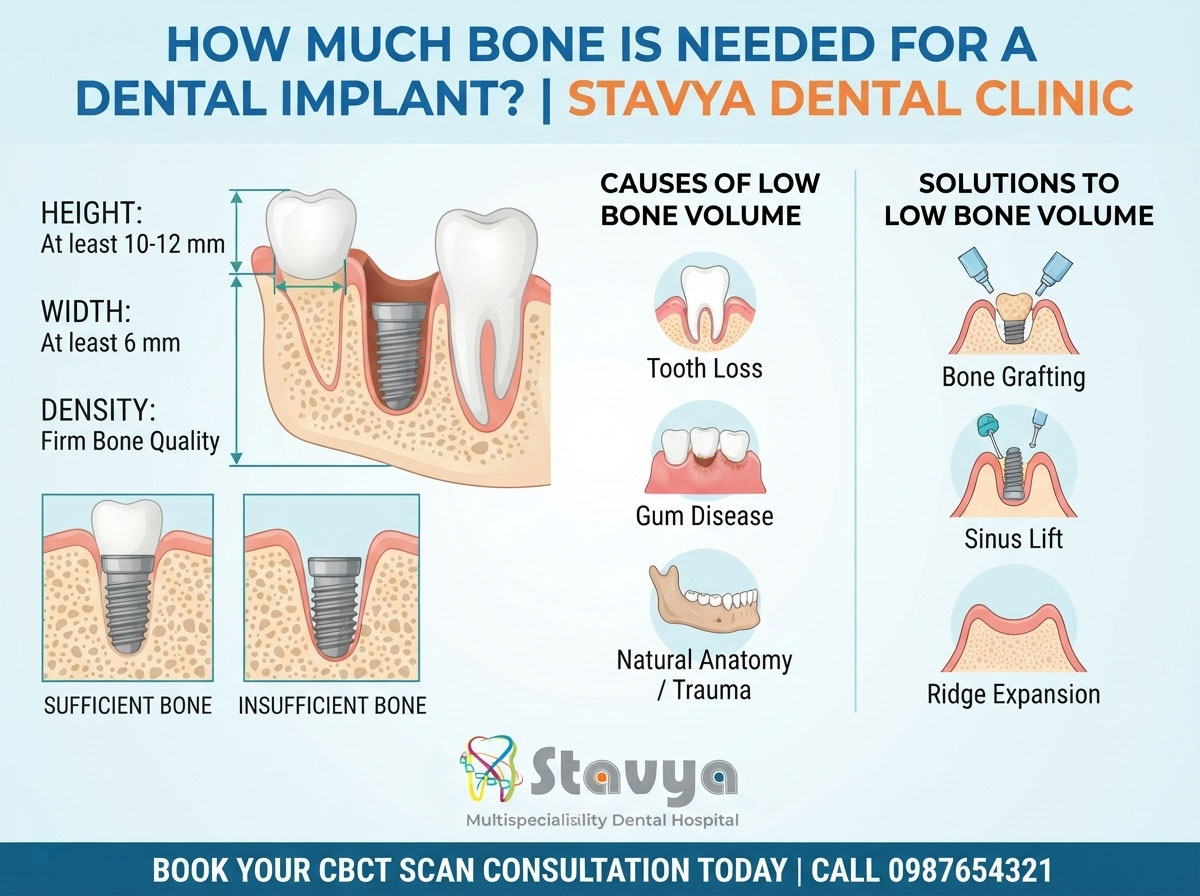
Every case is different, and a proper 3D scan is the only way to get an exact answer for your mouth — but as a general benchmark, dentists typically look for:
- Height: At least 10–12 mm of bone height, so the implant has enough vertical anchorage without encroaching on nearby nerves or sinus cavities.
- Width: At least 6 mm of bone width, so the implant sits fully surrounded by bone rather than poking through the outer edge of the ridge.
- Density: Bone that’s firm enough to hold the implant securely — soft, porous bone doesn’t provide the same stability even if the height and width look adequate on paper.
These numbers shift depending on the implant system being used and where in the mouth the tooth is missing. The upper back jaw (close to the sinuses) and the lower back jaw (close to the nerve canal) tend to be the most restrictive areas, which is why back-tooth implants are evaluated more conservatively than front-tooth ones.
How Bone Volume Is Actually Measured
A standard 2D dental X-ray can show bone height reasonably well, but it can’t reliably measure width or density. For that, a CBCT (cone beam computed tomography) scan is used — a specialized 3D imaging technique that gives your dentist a precise, cross-sectional view of the implant site before any surgery is planned. At Stavya Dental Clinic, this imaging is done through our radiology department, and it’s a standard part of the implant consultation, not an optional add-on.
What Causes Low Bone Volume in the Jaw?
Several everyday factors can leave a patient with less bone than an implant ideally needs:
- Tooth loss itself. Once a tooth is gone, the bone beneath it is no longer stimulated by chewing forces, so it begins to resorb (shrink) — often within just a few months of extraction. This is one of the biggest reasons dentists recommend planning implant treatment soon after an extraction rather than waiting for years.
- Long-term denture wear. Traditional removable dentures rest on the gums instead of stimulating the bone the way a natural tooth root or implant does, which can accelerate bone loss over years of wear.
- Gum disease (periodontitis). Advanced gum disease erodes the very bone that anchors teeth in place — often the same bone that would later be needed for an implant. Ongoing care through periodontics can help slow this process before more bone is lost.
- Trauma or untreated infection. Injuries to the jaw or long-standing infections near a tooth root can damage the surrounding bone structure.
- Natural anatomy. Some patients simply have a naturally thinner jaw ridge or larger sinus cavities, which leaves less usable bone in the upper back jaw regardless of oral health history.
If you’re noticing other changes around a tooth that’s been bothering you — for example, discomfort that lingers after brushing — it’s worth getting it checked early rather than waiting, the same way we recommend addressing issues covered in our post on why your teeth might hurt when you wake up.
What If You Don’t Have Enough Bone for an Implant?
This is the part that puts most patients at ease: not having enough bone today doesn’t mean an implant is permanently off the table. Depending on how much bone is missing and where, your dentist has several reliable ways to work with it:
- Bone grafting. Bone material — your own, from a donor, or synthetic — is added to the site to rebuild height and width before the implant is placed. Healing typically takes a few months before the site is ready for surgery.
- Sinus lift. For missing teeth in the upper back jaw, this procedure gently raises the sinus floor to create additional room for bone in that area.
- Ridge expansion. A narrow jaw ridge can sometimes be widened surgically to accommodate a standard implant, avoiding the need for a full graft.
- Shorter or narrower implants. In some cases, a smaller-diameter or shorter implant is a better fit than grafting, depending on the tooth’s location and the forces it will need to handle.
- All-on-4 or All-on-6 techniques. For patients with more significant bone loss across several teeth, implants can sometimes be angled into the denser bone that remains, reducing or eliminating the need for extensive grafting.
The right approach depends entirely on your specific scan results, the location of the missing tooth, and your broader oral health — which is exactly why a proper consultation and CBCT scan matter more than any general rule of thumb found online.
What to Expect After Bone Grafting or Implant Surgery
If your treatment plan includes bone grafting, sinus lift, or the implant surgery itself, healing time and aftercare play a big role in how successful the final result is. Our detailed breakdown of dental implant surgery recovery covers what the first few weeks typically look like, and our guide to dental implant surgery side effects walks through what’s normal versus what warrants a call to your dentist.
One factor that’s easy to overlook during recovery is nighttime teeth grinding, which can put unnecessary pressure on a healing implant site. If this applies to you, it’s worth reading our guide on when to consider a night guard before your procedure, not after.
Factors Beyond Bone Volume That Affect Implant Success
Bone height, width, and density are the starting point, but they’re not the only things your dentist weighs before recommending implant treatment. A few other factors commonly come into play:
- Overall gum health. Even with adequate bone, active gum disease needs to be brought under control first — placing an implant into inflamed tissue significantly raises the risk of failure. This is often addressed through periodontics before implant surgery is scheduled.
- Bite alignment and grinding habits. Excess pressure from a misaligned bite or nighttime grinding can stress a healing implant, which is part of why habits like bruxism are reviewed during planning, not just after surgery.
- Medical history. Conditions such as uncontrolled diabetes or osteoporosis, and habits like smoking, can slow bone healing and affect how well the implant fuses during osseointegration.
- Adjacent teeth and remaining tooth structure. If neighboring teeth have their own decay or bone loss, treating those issues — sometimes through root canal therapy or a filling — is usually folded into the overall treatment plan so the whole area heals together.
None of these factors are disqualifying on their own; they simply shape how your treatment plan is sequenced, and why implant planning at Stavya Dental Clinic always starts with a full-mouth evaluation rather than looking at the missing tooth in isolation.
How Long Does the Whole Process Take?
Patients often ask how long they should expect to wait between the first consultation and a fully restored tooth. The honest answer depends heavily on whether bone grafting is needed:
- No grafting needed: Implant placement can often move forward within a few weeks of the initial scan, followed by a healing period of roughly 3–6 months before the permanent crown is attached.
- Grafting or a sinus lift needed: Expect an additional 3–6 months of healing time before the graft site is dense enough to support the implant, on top of the standard osseointegration period afterward.
While this can feel like a long timeline, rushing implant placement into a site that isn’t ready is one of the more common causes of implant failure — so the extra healing time is almost always worth it for a result that lasts.
Cost Considerations When Bone Grafting Is Involved
It’s worth setting expectations early that a treatment plan involving bone grafting or a sinus lift will typically cost more than a straightforward implant placement, simply because it involves an additional procedure and healing phase. That said, skipping a necessary graft to save money upfront usually backfires — an implant placed into insufficient bone is far more likely to loosen or fail, which ends up costing more in the long run to correct. During your consultation, your dentist will walk you through exactly which steps your case needs so there are no surprises partway through treatment.
Frequently Asked Questions
Can I get a dental implant if I’ve had a tooth missing for years? Often yes, but the longer a tooth has been missing, the more likely it is that some bone grafting will be needed first, since bone resorption continues over time without a tooth root to stimulate it.
Does a bone graft hurt more than the implant itself? Most patients report that a bone graft feels similar to a tooth extraction in terms of discomfort, and it’s fully manageable with the same aftercare guidance used for standard dental implant surgery recovery.
How long does it take for a bone graft to heal before an implant can be placed? This typically ranges from a few months, depending on the size of the graft and the patient’s individual healing rate. Your dentist will confirm readiness with a follow-up scan before proceeding.
Is a CBCT scan always necessary before implant treatment? Yes — a standard 2D X-ray cannot accurately measure bone width or density, so a 3D CBCT scan (available through our radiology services) is a standard part of implant planning at Stavya Dental Clinic.
The Bottom Line
Most patients need roughly 10–12 mm of bone height and 6 mm of width for a standard dental implant, but bone loss from missing teeth, gum disease, or long-term denture wear can bring you below that threshold. The encouraging part is that modern dentistry has several dependable ways to rebuild or work around low bone volume, so very few patients are permanently ruled out of implant treatment.
If you’re considering a dental implant and aren’t sure whether you have enough bone, the team at Stavya Dental Clinic can evaluate your jaw with a detailed CBCT scan and walk you through the right path forward — whether that’s straightforward implant placement or a bone-building procedure beforehand. You can also browse more patient guides in our Dental Implants and Dental Implants Work categories, or read about our implant services in Ahmedabad.
This article is for general educational purposes and isn’t a substitute for an in-person dental evaluation.