Almost everyone has heard a version of this question: “Can a cavity go away on its own?” You may have seen social media posts promising to heal cavities with oil pulling, special diets or herbal pastes. The truth sits somewhere between the hype and the pessimism, and knowing it can save you a filling, a root canal or even a tooth.
At Stavya Dental Clinic, we explain to patients that tooth decay is a process and not a single event. In its earliest stage, that process can be slowed, stopped and even reversed. Once it has broken through the tooth surface and formed a hole, it cannot heal itself and needs professional treatment.
This guide explains exactly where that line is, what early tooth decay looks like, and what you can do at home and in the dental chair.
Short Answer: Can Cavities Be Reversed?
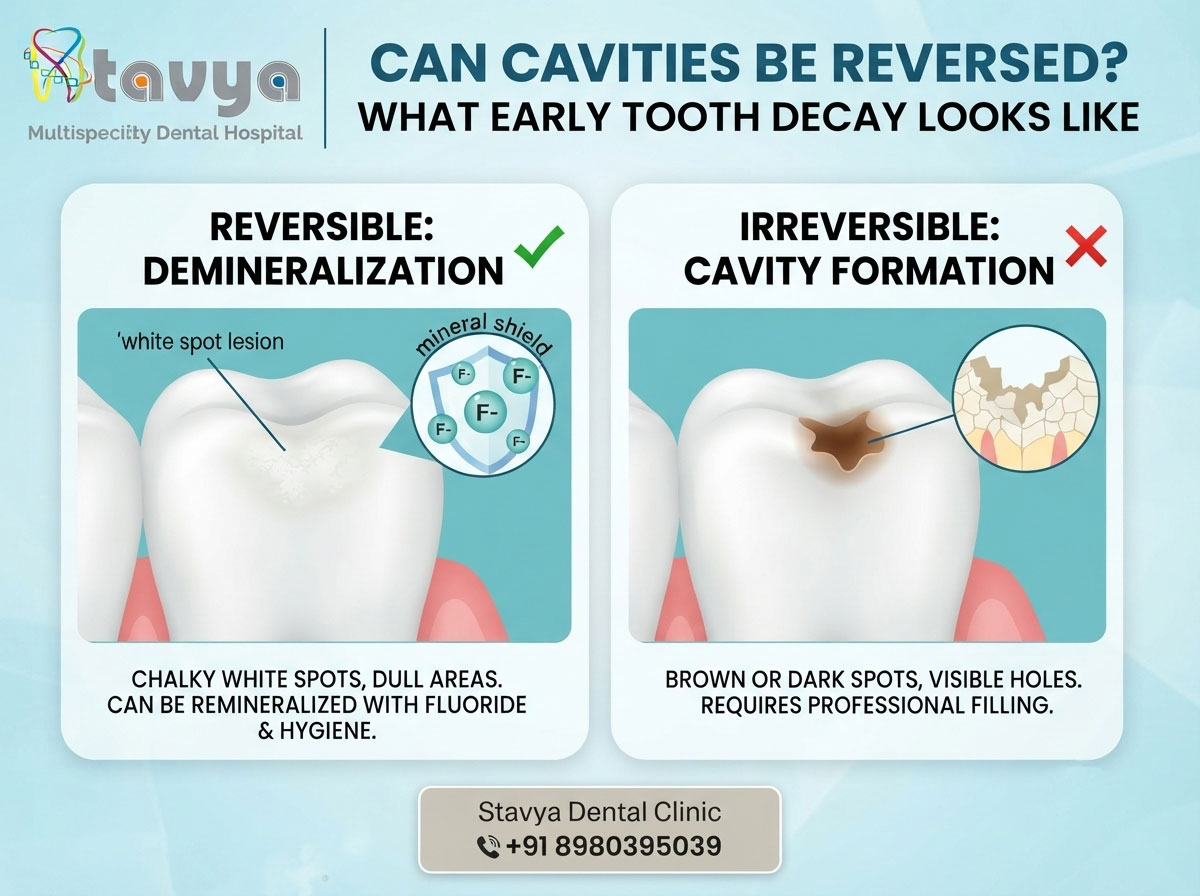
Only the earliest stage of tooth decay can be reversed. This stage is called demineralization, or a “white spot lesion”, and happens before a hole forms in the tooth. At this point the enamel has lost minerals but its surface is still intact, so it can take minerals back in a process called remineralization.
Once a hole (cavity) has formed, the lost tooth structure cannot grow back. The tooth needs a filling or other restoration to stop the decay from spreading.
So the useful question is not “can cavities be reversed?” but “how early can I catch it?”
How a Cavity Forms: The Science in Plain Words
Your mouth contains hundreds of types of bacteria. Some of them feed on sugars and refined carbohydrates from your food and drink, and they produce acid as a by-product. That acid dissolves the minerals (mainly calcium and phosphate) that make enamel hard.
Two opposing processes happen in your mouth every day:
- Demineralization: acid pulls minerals out of enamel. It happens after you eat or drink anything sugary or starchy.
- Remineralization: saliva neutralizes acid and returns minerals to the enamel, helped by fluoride.
If demineralization wins over time, a cavity forms. If remineralization keeps up, the tooth stays healthy. Early decay is that battle in progress, which is why it is reversible.
Saliva is a big part of this defence. If your mouth is often dry, the balance tips towards decay, which we cover in dry mouth and tooth decay: why low saliva can damage your teeth.
The Stages of Tooth Decay
Stage 1: Demineralization (white spot lesion)
The enamel loses minerals but the surface remains intact. This is the only reversible stage.
What it looks like: Chalky white spots or patches, most often near the gum line, around braces or between teeth. The spot may look dull compared with the shiny enamel around it.
How it feels: Usually nothing. Most people have no symptoms.
Stage 2: Enamel decay
The surface breaks and a small cavity forms in the enamel. It cannot heal by itself.
What it looks like: The white spot may turn light brown, and you may feel a tiny rough patch or pit with your tongue.
How it feels: Often still painless, though some people notice slight sensitivity.
Stage 3: Dentin decay
Decay passes through the enamel into dentin, the softer layer underneath. Dentin contains tiny tubes that lead to the nerve, so symptoms often start here. Decay also spreads faster in dentin.
What it looks like: Brown or dark spots, visible holes, or shadows beneath the enamel.
How it feels: Sensitivity to sweet, hot or cold foods, and pain when biting.
Stage 4: Pulp involvement
Bacteria reach the pulp, the inner chamber that holds nerves and blood vessels. This causes inflammation or infection.
How it feels: Lingering or throbbing toothache, pain at night, swelling, or a bad taste. Treatment usually requires root canal treatment. You can read more about this stage in what happens if a tooth infection is left untreated.
Stage 5: Abscess
Infection spreads beyond the root tip and forms a pocket of pus. It can cause severe pain, facial swelling and fever, and needs urgent attention.
What Early Tooth Decay Looks Like
Because early decay is usually painless, you have to know what to look for. Watch for:
- Chalky white patches on the tooth, especially near the gum line
- White lines or spots around braces that remain once brackets are removed
- Dull, matte areas where enamel used to be shiny
- Light brown or yellow-brown stains in grooves of back teeth
- A rough or sticky spot you can feel with your tongue
- Food repeatedly getting stuck in one spot between teeth
- Occasional mild sensitivity to cold or sweets that comes and goes
- Bad breath that persists despite good brushing, which can be linked to decay or gum disease (see why your breath smells even after brushing)
A quick word of caution: not every white spot is decay. White spots can also be caused by fluorosis (too much fluoride during tooth development) or enamel defects. Only a dentist can tell which it is, so please do not assume.
Why Your Dentist Can See What You Cannot
Many early cavities form between teeth or in the chewing grooves, where you cannot easily see them. At Stavya Dental Clinic, we use several tools to find them early:
- Visual and tactile examination under good lighting and magnification
- Digital dental X-rays through our radiology service, which reveal decay between teeth and under existing fillings that is invisible to the eye
- Laser-based and other detection aids where suitable, as part of our laser treatment technology
A comprehensive dental checkup every six months gives us the chance to notice a white spot while it can still be healed. Waiting until it hurts often means waiting until it needs a filling.
How to Help Early Decay Reverse
If your dentist confirms that decay is at the early stage, the aim is to tip the balance towards remineralization. This is how.
1. Use fluoride toothpaste twice a day
Fluoride is the best-proven tool for remineralizing enamel. It helps rebuild the tooth surface with a harder, more acid-resistant mineral. Brush for two minutes, morning and before bed. Then spit but do not rinse with water, so a thin film of fluoride stays on the teeth.
2. Get professional fluoride treatment
Your dentist can apply fluoride varnish or gel, which is stronger than toothpaste. It is quick, painless and especially useful for children, patients with braces, people with dry mouth and anyone with a history of cavities. Our pedodontics team offers this for children.
3. Cut down how often you eat sugar
Frequency matters more than amount. Every sugary snack or sip starts an acid attack that lasts around 20 to 30 minutes. Sipping sweetened tea, coffee or soft drinks all day keeps your teeth under constant attack.
- Keep sweets to mealtimes instead of grazing
- Choose water between meals
- Limit sticky foods that cling to teeth, such as toffees and dried fruit
- Avoid sipping fizzy or sweetened drinks for long periods
4. Clean between your teeth
A toothbrush cannot reach the sides of your teeth, where many cavities begin. Floss or interdental brushes once a day remove the plaque that produces acid.
5. Stimulate saliva
Drink water regularly and chew sugar-free gum after meals, which boosts saliva flow. Gum containing xylitol may also help reduce decay-causing bacteria. If you suffer from constant dry mouth, tell your dentist because a cause needs to be found.
6. Consider sealants
Pit and fissure sealants are thin protective coatings placed over the deep grooves of back teeth, most often in children and teens. They keep food and bacteria out of the places where cavities most often start.
7. Return for monitoring
An early lesion needs to be checked again within a few months to confirm that it is healing. If it is getting worse despite your efforts, it needs treatment.
What About “Natural” Ways to Reverse Cavities?
The internet is full of claims that oil pulling, herbal powders, special diets or supplements can heal cavities. Here is what we tell patients.
- Good news: Some habits are useful as support, such as a balanced diet with calcium and vitamin D, drinking water and reducing sugar. These help your teeth stay healthy.
- Reality: There is no reliable scientific evidence that oil pulling or herbal remedies can rebuild lost tooth structure or heal an existing cavity.
- The risk: Trusting these methods can let a small, treatable cavity grow into a large one. Delaying care is the most costly mistake.
If you like natural products, use them in addition to fluoride and dental visits, not instead of them.
When Do You Need a Filling?
Remineralization cannot repair a hole. You will likely need a filling when:
- There is a visible pit, hole or dark shadow in the tooth
- Your dentist can feel the surface has broken through
- The decay has reached dentin, as shown on an X-ray
- You have sensitivity or pain on chewing
Modern tooth-coloured fillings bond to the tooth and match its shade, so treatment can be conservative and blend in with your smile. Where a tooth has been weakened or heavily restored, a crown may be advised. If the tooth was damaged by a chip rather than decay, see chipped tooth: when is dental bonding enough and when is a crown needed.
If decay has reached the nerve, a root canal can save the tooth. Some root canals later need repeat treatment, which we explain in why some root canals need retreatment.
Who Is Most at Risk of Cavities?
Some people have a higher chance of decay than others. Risk goes up if you:
- Snack or sip sugary drinks often through the day
- Have a dry mouth, or take medications that reduce saliva
- Wear braces, aligners or other appliances that trap plaque (our orthodontics team gives patients hygiene guidance for this reason)
- Have exposed root surfaces from gum recession (see our periodontics service)
- Have crowded teeth that are hard to clean
- Have had many cavities before
- Skip regular dental check-ups
If you notice gum bleeding as well, read why gums bleed even if you brush every day, since gum disease and decay often appear together.
Cavities in Children
Children’s teeth have thinner enamel, so decay spreads faster, and baby teeth matter because they hold space for adult teeth and help with speech and chewing. Habits that raise risk include bottle feeding at night, sweet snacks and inconsistent brushing. Parents should supervise brushing until about age seven or eight and book regular visits with a paediatric dentist. Our pedodontics service is designed to make these visits comfortable.
Cosmetic Concerns After Early Decay
White spots that remain after remineralization, or after braces, may still be visible. Depending on the case, your dentist may suggest microabrasion, resin infiltration or bonding to improve appearance. Our aesthetic dentistry team can advise you on choices and whether teeth whitening would suit you.
Prevention: A Daily and Yearly Routine
Every day:
- Brush twice with fluoride toothpaste for two minutes
- Clean between teeth once a day
- Limit how often you snack and sip sugary drinks
- Drink water after meals
Every year:
- Two dental check-ups and cleanings
- X-rays when your dentist recommends them
- Fluoride treatment if you are at higher risk
For life:
- Do not ignore small changes in your teeth
- Do not rely on home remedies for existing cavities
- Keep your gums healthy, since exposed roots decay easily
Frequently Asked Questions
Can a cavity heal on its own?
Only in its earliest stage, before the surface breaks. Once there is a hole in the enamel, it cannot repair itself and needs a filling.
Can a white spot on my tooth go away?
Sometimes. If it is early decay, fluoride, better hygiene and less frequent sugar can help it harden and stop progressing. It may still look slightly white afterwards, and a dentist needs to confirm the cause.
How long does it take to reverse early tooth decay?
It varies, but it usually takes weeks to months of consistent care and follow-up, not days.
Does a cavity always hurt?
No. Early cavities often cause no pain at all, which is why regular check-ups matter.
Is oil pulling a substitute for fluoride?
No. Fluoride has strong scientific support for remineralizing enamel. Oil pulling does not have that evidence base for treating cavities.
How often should I visit a dentist to catch cavities early?
Most people should go every six months, and those at higher risk may need more frequent visits.
Can I get a cavity under a filling?
Yes. Decay can form at the edges of an old filling, so we monitor them with examinations and X-rays.
Book a Check-Up at Stavya Dental Clinic
If you have noticed a white spot, a rough patch or new sensitivity, do not wait for it to hurt. Caught early, a cavity can often be managed with simple, comfortable care. Caught late, it may need a filling, a root canal or a crown.
At Stavya Dental Clinic, we combine careful examination, digital imaging and personalised prevention advice to protect your teeth at every age.
Book your appointment today:
- Call us on +91 8980395039
- Send an online inquiry
- Visit our contact page or explore more on our dental blog
Disclaimer: This article is for general education only and is not a substitute for a personal dental examination or professional advice.