You’ve been told you have a cavity. It doesn’t hurt. Life is busy. So you tell yourself you’ll “get to it” — next month, after the festival season, once work calms down. Millions of people make exactly this bet every year, and dentists at Stavya Dental Clinic see the outcome of that bet on a weekly basis: sometimes it costs nothing extra, and sometimes it costs a tooth.
Here’s the timeline of what actually happens inside a tooth when a cavity is left untreated — and where the “safe to wait” window realistically closes.
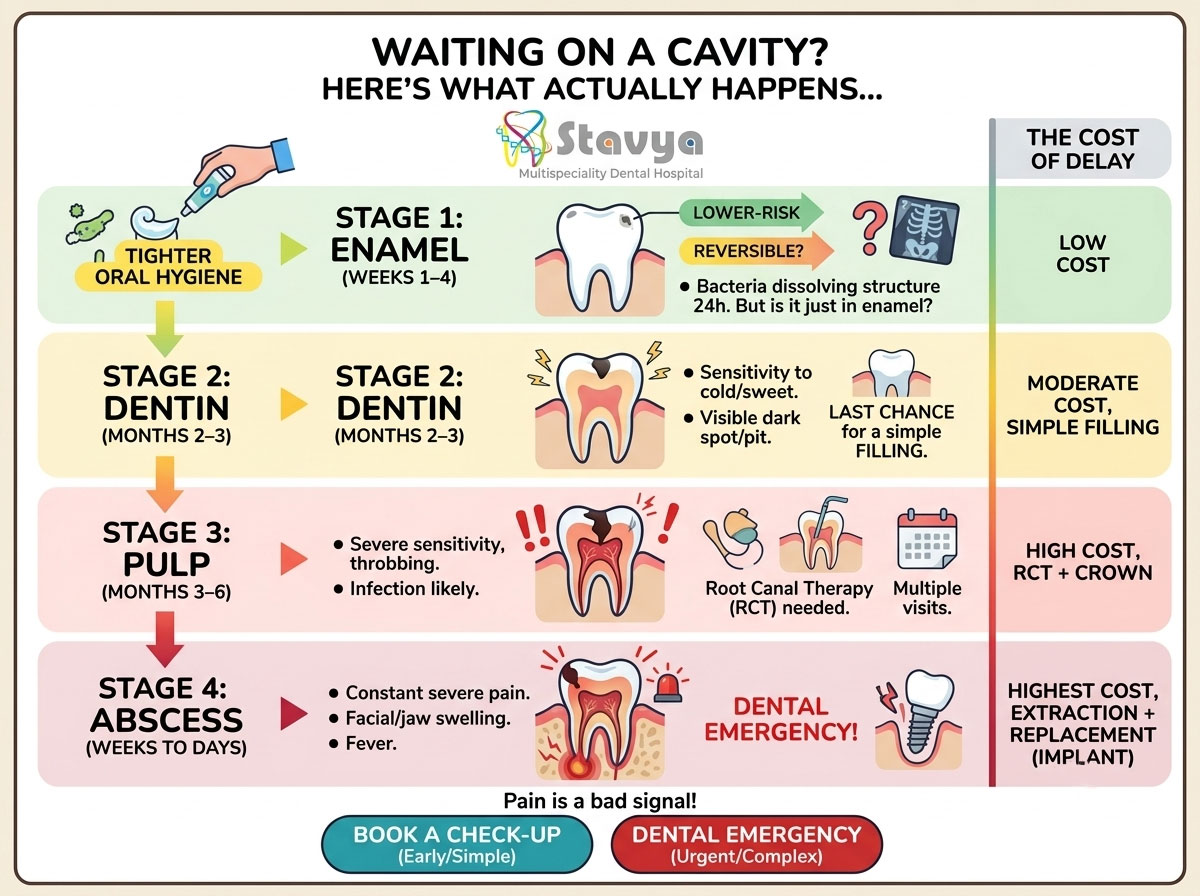
Week 1–4: The Cavity Doesn’t Care That You’re Busy
In the first few weeks after a cavity is diagnosed, most people notice nothing different. That’s precisely the danger. A cavity is bacteria actively dissolving your tooth’s structure with acid, 24 hours a day, whether or not you feel it. There’s no “pause” button.
If the cavity was caught early — limited to the outer enamel — this window is genuinely lower-risk. Early enamel decay can sometimes even be reversed with fluoride treatment and tighter oral hygiene, avoiding a filling altogether. This is the one scenario where “waiting a bit” while you get a professional opinion isn’t dangerous.
But here’s the catch: you can’t tell how early-stage your cavity is by looking in the mirror. Only a dental exam — often with an X-ray — can confirm whether you’re in this low-risk window or already past it. Booking a check-up is what tells you which bet you’re actually making.
Month 2–3: Decay Reaches the Dentin
Once decay eats through the enamel into the dentin layer underneath, the pace picks up. Dentin is softer and more porous, so it offers far less resistance to acid than enamel did. This is usually the point where people start noticing:
- Twinges when eating something cold or sweet
- A visible dark spot or small pit
- Mild discomfort when biting on that side
This is also, not coincidentally, the last stage where a straightforward, single-visit filling is the likely treatment. Filling a cavity at this stage is fast, affordable, and preserves nearly all of your natural tooth. Wait past it, and the next treatment tier gets significantly more involved.
Month 3–6: Decay Reaches the Pulp
If dentin decay isn’t addressed, it eventually reaches the pulp — the nerve- and blood-vessel-rich core of the tooth. This is usually where “I’ll deal with it later” stops being an option, because the pain becomes hard to ignore: sharp sensitivity, throbbing, pain that lingers well after the trigger (hot coffee, cold water) is gone.
Once bacteria reach the pulp, infection is likely. Treatment at this stage generally means root canal therapy — removing the infected tissue, cleaning and sealing the canal, and usually placing a crown afterward to protect what’s left of the tooth’s structure. The tooth can usually still be saved here — but the treatment is now several times more involved (and more expensive) than the filling that would have handled it three months earlier.
Weeks to Days: When an Abscess Forms
Left untreated further, infection can spread past the tooth into the surrounding gum and bone, forming an abscess — a painful, pus-filled pocket. Unlike the slower stages before it, this can escalate over days rather than months. Watch for:
- Severe, constant, throbbing pain
- Facial or jaw swelling
- Fever
- A persistent foul taste
This is a genuine dental emergency, not a “book it when convenient” situation. In rare but serious cases, untreated dental infections can spread beyond the mouth. At this point, the tooth may no longer be salvageable, and extraction — followed by a replacement option — becomes the likely path.
What Waiting Actually Costs You (Not Just in Pain)
| Stage | Typical Treatment | Visits Needed | Relative Cost |
|---|---|---|---|
| Early enamel decay | Fluoride treatment / monitoring | 1 | Lowest |
| Dentin decay | Filling | 1 | Low |
| Pulp involvement | Root canal + crown | 2–3 | Moderate–High |
| Abscess / unsalvageable tooth | Extraction + replacement (implant/bridge/denture) | 3+ | Highest |
Every stage you let a cavity progress through adds cost, appointments, and recovery time — while removing options. A filling can only be offered while there’s still enough healthy tooth structure to fill; wait too long, and that option is simply off the table.
“Should I Wait?” — A Quick Decision Guide
No pain, cavity just diagnosed, no visible hole yet → Low urgency, but confirm the stage with a dentist before deciding to wait at all.
Mild sensitivity to hot/cold/sweet, small visible spot → Book a filling appointment soon — this is the window where treatment is still simple.
Sharp or throbbing pain, pain that lingers → Don’t wait. This suggests pulp involvement; delaying risks losing the tooth’s chance of a root canal in favor of extraction.
Swelling, fever, severe pain → Treat as an emergency. Seek same-day dental care.
It’s been over a year since your last dental visit → Even without obvious symptoms, book a check-up — cavities are frequently found before they cause any pain at all, especially in children, where decay can progress faster and where pediatric dental care is especially time-sensitive.
Why Pain Is a Bad Signal to Wait For
The instinct to wait until something hurts is understandable, but it works against you here. Painless cavities are almost always the early, cheap, simple-to-fix ones. Pain shows up once decay has already reached the dentin or pulp — meaning by the time your tooth “tells you” to act, you’ve usually already missed the window for the least invasive treatment. The only reliable way to catch a cavity while it’s still simple is a dental exam, not a pain threshold.
Frequently Asked Questions
Is there a cavity that’s actually safe to leave untreated? No cavity is safe to leave untreated indefinitely. The closest thing to “safe to wait” is a very early, enamel-only spot confirmed by a dentist — and even then, “wait” means getting it monitored and treated with fluoride, not ignored.
Can I just manage a cavity with better brushing instead of a filling? Only if it hasn’t yet formed an actual hole. Once there’s a cavity (a hole), brushing can’t reverse it — the structure is already gone and needs to be restored.
How fast can a cavity turn into a root canal situation? It varies by person, but decay can move from dentin to pulp involvement within a few months, especially with high sugar intake, poor oral hygiene, or existing risk factors like dry mouth.
What if I have no insurance or a tight budget — should I still wait less? This is actually the strongest argument for not waiting. Every stage of delay increases the eventual cost. A filling today is reliably cheaper than a root canal in six months.
Do children’s cavities progress faster than adults’ cavities? Often yes — baby teeth have thinner enamel and dentin, so decay can reach the pulp more quickly than in adult teeth. This is why cavities in children are generally treated with more urgency.
The Bottom Line
A cavity is one of the few dental problems where the “cost of waiting” is measurable, predictable, and always moving in the wrong direction. There’s no version of ignoring a cavity that makes it smaller, cheaper, or easier to treat later — only versions where it stays roughly the same for a while, and versions where it escalates quickly. The only way to know which one you’re dealing with is to have it looked at.
If you’ve been sitting on a cavity diagnosis — or it’s simply been a while since your last visit — Stavya Dental Clinic can tell you exactly where it stands and the least invasive way to treat it from here. Book an appointment or contact us to get it checked before “later” becomes “urgent.”
Related reading: Common Dental Treatments: What to Expect at Your Dentist Visit | Dental Emergency or Can It Wait? 10 Situations That Need Urgent Care | How Can I Prevent Cavities in Toddler Teeth
This article is general information, not a diagnosis. Every mouth is different, so please see a dentist for advice about your own teeth.