Most people think of dry mouth as a minor annoyance — the kind of thing you fix with a sip of water and forget about. But saliva is one of the hardest-working, least appreciated parts of your oral health system, and when it’s in short supply, the consequences go far beyond a parched feeling. Chronically low saliva — a condition dentists call xerostomia — is one of the most overlooked causes of rapid, aggressive tooth decay.
At Stavya Dental Clinic, we regularly see patients who brush and floss diligently, yet still develop cavities again and again. In a large number of these cases, the root cause isn’t poor hygiene — it’s dry mouth. Understanding why saliva matters, what causes it to dry up, and how to protect your teeth when it does, can save you from years of unnecessary fillings, root canals, and dental discomfort.
What Is Dry Mouth (Xerostomia)?
Dry mouth, medically known as xerostomia, occurs when your salivary glands don’t produce enough saliva to keep your mouth adequately moist. It isn’t a disease in itself — it’s usually a symptom of something else, whether that’s a medication side effect, a health condition, a lifestyle habit, or simply getting older.
Occasional dry mouth — after a stressful meeting, a workout, or a bad night’s sleep — is completely normal and harmless. The concern is chronic dry mouth, where your saliva flow stays consistently low over weeks, months, or years. That’s when your teeth lose one of their most important natural defenses.
Why Saliva Matters More Than You Think
Saliva isn’t just water. It’s a finely balanced fluid that performs several jobs your teeth depend on every single day:
- Rinsing away food debris and bacteria before they can settle on your teeth and form plaque.
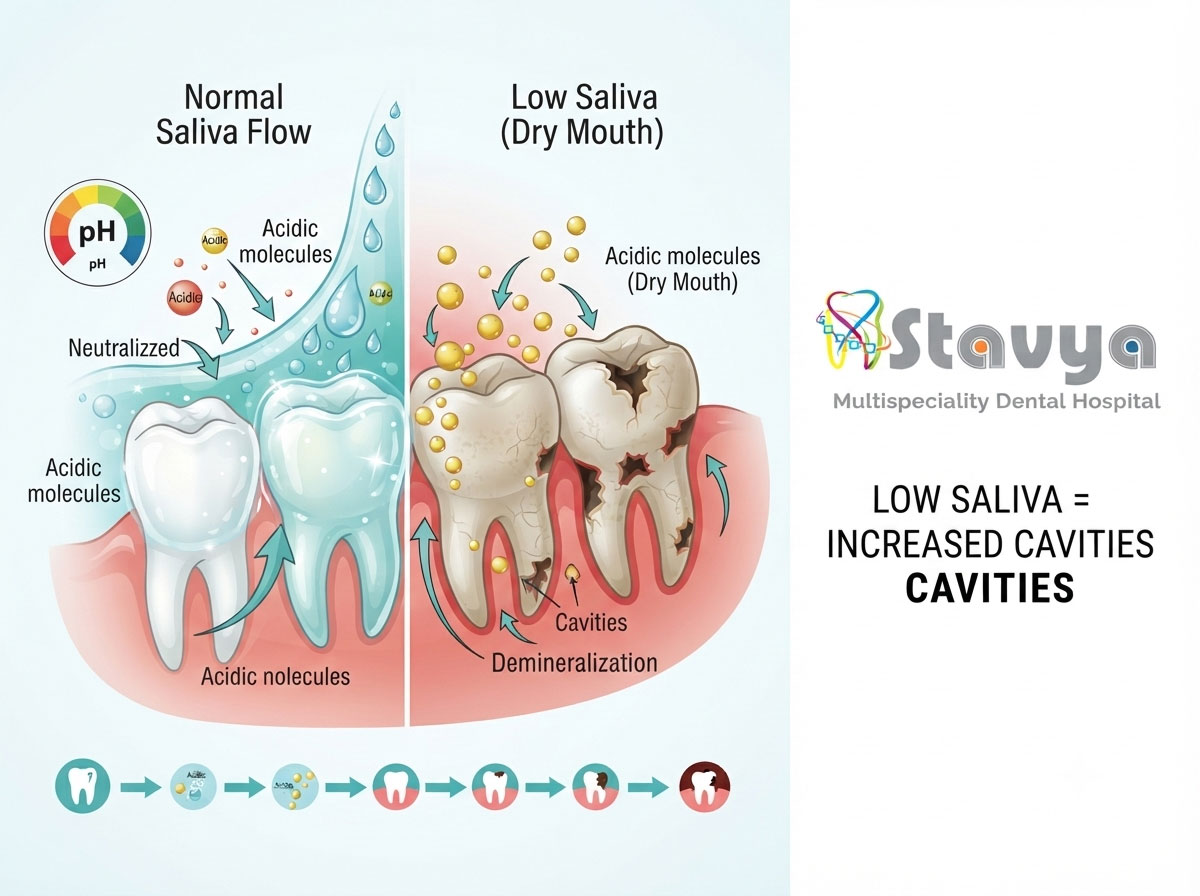
- Neutralizing acid. Every time you eat, bacteria in your mouth produce acid as a byproduct. Saliva buffers that acid, bringing your mouth back to a safe pH.
- Remineralizing enamel. Saliva is rich in calcium and phosphate, minerals that continuously repair the microscopic damage acid causes to your enamel — essentially healing your teeth in real time.
- Controlling bacteria levels. Saliva contains antibacterial compounds that keep harmful, cavity-causing bacteria like Streptococcus mutans in check.
- Aiding digestion and comfort, making it easier to chew, taste, and swallow.
When saliva flow drops, every one of these protective functions weakens at the same time — which is exactly why dry mouth can turn into a decay problem so quickly.
How Low Saliva Leads to Tooth Decay
Here’s the chain reaction that plays out inside a dry mouth:
- Without enough saliva to rinse it away, plaque builds up faster and sticks more stubbornly to tooth surfaces.
- Acid produced by that plaque isn’t neutralized properly, so your enamel stays in an acidic, demineralizing state for longer after every meal or snack.
- With less calcium and phosphate circulating, your enamel can’t repair itself as effectively, so early decay isn’t reversed the way it normally would be.
- Bacteria multiply faster in a dry environment, increasing your overall cavity risk — including in places that rarely decay in a well-hydrated mouth, like the smooth surfaces of front teeth and along the gumline.
This is why people with chronic dry mouth often develop decay in unusual patterns — around old fillings, near the gumline, or on multiple teeth at once — rather than the occasional cavity in a back molar.
Common Causes of Dry Mouth
Dry mouth has a long list of possible triggers, and most patients are dealing with more than one at a time:
- Medications — over 500 common drugs list dry mouth as a side effect, including antihistamines, antidepressants, blood pressure medications, and painkillers.
- Aging — salivary gland function naturally declines with age, which is one reason dry mouth is so common among older adults (we cover this in detail in our guide to dental care for seniors).
- Mouth breathing and snoring — breathing through your mouth, especially at night, dries out oral tissue quickly.
- Dehydration — not drinking enough water reduces saliva production almost immediately.
- Diabetes — poorly controlled blood sugar is strongly linked to reduced saliva flow.
- Sjögren’s syndrome and other autoimmune conditions — these directly attack the salivary glands.
- Cancer treatment — radiation therapy to the head and neck, and certain chemotherapy drugs, can significantly reduce saliva production, sometimes permanently.
- Tobacco, alcohol, and caffeine use — all three have a drying effect on oral tissue.
- Stress and anxiety — can suppress saliva production during periods of high tension.
Signs and Symptoms You Shouldn’t Ignore
Dry mouth doesn’t always feel dramatic. Watch for:
- A sticky, cotton-like feeling in the mouth
- Frequent thirst
- A dry, rough, or cracked tongue
- Difficulty chewing, speaking, or swallowing
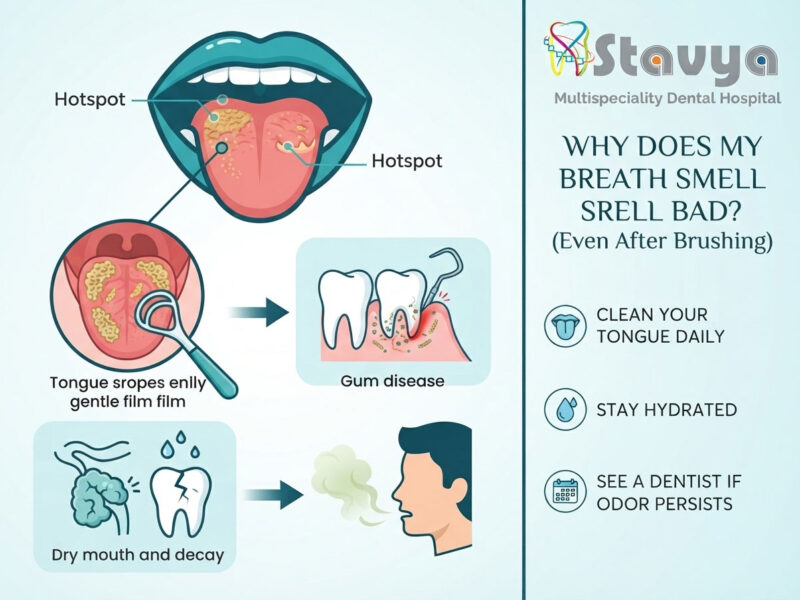
- Persistent bad breath
- A burning sensation in the mouth
- Cracked lips or sores at the corners of the mouth
- Difficulty wearing dentures comfortably
- A sudden increase in cavities, especially in areas that were previously healthy
If you’re noticing several of these together — particularly alongside new or repeated cavities — it’s worth raising dry mouth specifically with your dentist, rather than treating each symptom separately.
Who’s Most at Risk?
While anyone can experience dry mouth, certain groups face significantly higher risk:
- Older adults, due to natural gland changes and higher rates of medication use
- People managing chronic conditions like diabetes or autoimmune disorders
- Cancer patients and survivors, especially after head or neck radiation
- People on long-term prescriptions for blood pressure, depression, anxiety, or allergies
- Smokers and heavy alcohol or caffeine users
- Mouth breathers, including many people with sleep apnea or chronic congestion
If you fall into one or more of these categories, it’s worth being proactive about saliva-related decay rather than waiting for a cavity to show up on an X-ray.
Dental Problems Linked to Chronic Dry Mouth
Left unmanaged, low saliva doesn’t just cause the occasional cavity — it opens the door to a cluster of oral health problems:
- Rapid, widespread tooth decay, including root and gumline cavities
- Gum disease, since bacteria accumulate faster without saliva’s natural rinsing action — something we also address under periodontics
- Bad breath (halitosis) caused by bacterial buildup
- Oral thrush and other infections, since saliva normally helps control fungal and bacterial growth
- Mouth sores and difficulty wearing dentures, due to a lack of natural lubrication
- Enamel erosion, making teeth more sensitive and prone to chipping
How We Diagnose and Treat Dry Mouth-Related Decay
At Stavya Dental Clinic, addressing dry mouth-related decay usually involves two parallel tracks: treating the damage that’s already there, and managing the saliva problem so it doesn’t keep happening.
Treating existing decay:
- Fillings — for early-to-moderate cavities, dental fillings restore the tooth structure and stop decay from spreading further.
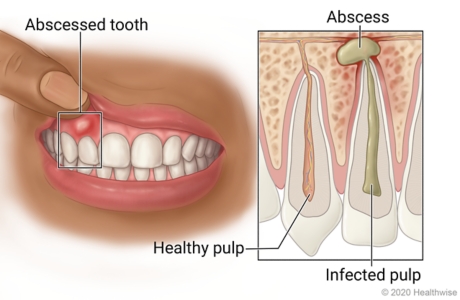
- Root canal treatment (RCT/Endodontics) — if decay has progressed deep enough to reach the nerve, root canal treatment removes the infection and saves the tooth. You can read more about what this involves in our post on what to expect during a root canal treatment.
- Crowns and bridges — for teeth significantly weakened by decay, a crown can restore strength and protect the tooth from further breakdown.
- Periodontal care — if dry mouth has contributed to gum inflammation or early gum disease, our periodontics treatments address the gum tissue directly.
Managing the underlying dry mouth:
- Reviewing your medications with your physician to identify drying side effects
- Prescription or over-the-counter saliva substitutes and stimulants
- Custom fluoride treatments to strengthen enamel against acid
- A tailored home-care routine designed specifically for a low-saliva mouth
Not sure how far your decay has progressed? Our article on how long a cavity can actually wait before it becomes a bigger problem is a useful next read.
Prevention: Protecting Your Teeth When Saliva Is Low
You can’t always control why your mouth is dry, but you can control how much damage it does to your teeth. A few habits make a significant difference:
- Sip water throughout the day, rather than large amounts infrequently. Keep a water bottle within reach, especially during and after meals.
- Chew sugar-free gum or suck on sugar-free lozenges — this stimulates natural saliva production without feeding decay-causing bacteria.
- Use a fluoride toothpaste and, if recommended, a fluoride mouth rinse to help enamel resist and repair acid damage.
- Avoid or limit caffeine, alcohol, and tobacco, all of which worsen dryness.
- Consider a humidifier at night, especially if you breathe through your mouth while sleeping.
- Ask about saliva substitutes — gels, sprays, and rinses designed specifically for xerostomia can provide relief and protection between dental visits.
- Cut back on sugary and acidic foods and drinks, since your mouth has less natural ability to buffer and rinse them away.
- Don’t skip regular dental checkups. Dry mouth-related decay can progress faster than typical cavities, so more frequent monitoring is often worthwhile.
When to See a Dentist
Book an appointment if you notice:
- New cavities appearing more frequently than in the past
- Persistent dryness that doesn’t improve with water
- Pain, sensitivity, or visible dark spots on your teeth
- Difficulty wearing dentures or partials comfortably
- Ongoing bad breath despite good oral hygiene
If you’re dealing with sudden pain or swelling on top of dry mouth symptoms, don’t wait it out — our guide on dental emergencies and when they can’t wait can help you figure out how urgently you need care.
Frequently Asked Questions
Can dry mouth really cause cavities, or is it just uncomfortable? Yes — low saliva removes one of your teeth’s main defenses against acid and bacteria, which measurably increases cavity risk, not just discomfort.
Is dry mouth reversible? It depends on the cause. Dehydration- or medication-related dry mouth often improves once the trigger is addressed. Age-related or medical-condition-related dry mouth may be more about ongoing management than a full reversal.
Does drinking more water alone fix dry mouth? It helps, but it usually isn’t a complete fix on its own — especially if the cause is medication or a medical condition. Water should be paired with the other prevention steps above.
Are certain teeth more likely to decay from dry mouth? Yes. Root surfaces, areas near the gumline, and smooth front-tooth surfaces — areas that rarely decay in a well-hydrated mouth — become much more vulnerable when saliva is low.
Can dry mouth affect dentures too? Yes. Saliva helps dentures stay in place and prevents irritation. Chronic dry mouth can make dentures feel loose, uncomfortable, or prone to sores.
The Bottom Line
Dry mouth is easy to dismiss — until it starts showing up as cavities you can’t explain. If your teeth are decaying faster than they used to, or you’re constantly reaching for water without relief, low saliva may be the hidden factor. The good news is that once it’s identified, it’s very manageable with the right combination of dental treatment and daily habits.
At Stavya Dental Clinic, we look beyond the cavity itself to understand why it happened — because treating the symptom without addressing dry mouth just means treating the next cavity, and the one after that.
Concerned about dry mouth or recurring cavities? Contact Stavya Dental Clinic or book an inquiry to schedule an evaluation.
Related Reading
- Dental Care for Seniors: Maintaining Natural Teeth and Gum Health in Your 60s and Beyond
- How Long Can a Cavity Actually Wait Before It Becomes a Bigger Problem?
- What to Expect During a Root Canal Treatment
- Dental Emergency or Can It Wait? 10 Situations That Need Urgent Care