The word “laser” often conjures up images from science fiction movies—high-powered, cutting beams of light utilized in futuristic landscapes. When patients discover that lasers are now widely used in modern dental practices, it can spark a mix of fascination and apprehension. A common question echoing through dental consultation rooms today is: “How safe is laser dentistry, really?”
At Stavya Dental Hospital, we believe that patient education is the cornerstone of exceptional clinical care. As a premier multispecialty dental care provider, we stay at the cutting edge of advanced medical technologies. Laser dentistry is not a futuristic concept; it is a highly refined, safe, and incredibly gentle treatment modality that we use daily to elevate the patient experience.
To help you separate anxiety-inducing misconceptions from clinical reality, we have put together this definitive guide outlining the safety, mechanics, facts, and myths surrounding laser dentistry.
What Exactly Is Laser Dentistry?
To evaluate the safety of dental lasers, it helps to understand what they actually are. The word LASER is an acronym for Light Amplification by Stimulated Emission of Radiation.
In regular dental treatments, a dentist relies on mechanical friction—such as the spinning of a diamond bur in a dental drill or the sharp edge of a hand scalp—to alter oral tissues. Laser dentistry replaces or complements these mechanical tools with an incredibly focused, intense beam of light energy.
How Laser Energy Interacts with Your Mouth
When the laser light hits the targeted area (whether it is a cavity, a section of diseased gum tissue, or an enamel stain), it reacts with specific components in the tissue, such as water, hydroxyapatite (the mineral in your teeth), or hemoglobin (in your blood). The tissue absorbs this light energy, allowing the dentist to gently vaporize or shape the area with micro-precision.
In a modern practice like Stavya Dental Hospital, lasers are generally split into two primary categories:
- Hard Tissue Lasers: Specifically calibrated to slice through bone and teeth with pinpoint accuracy. They are used to prepare teeth for fillings, remove old composite material, and shape bone structure.
- Soft Tissue Lasers: Highly absorbed by hemoglobin and water, making them ideal for gum reshaping, treating periodontal pockets, performing frenectomies, and eliminating oral ulcers.
The Ultimate Safety Verdict: Is It Safe?
The short answer is yes, laser dentistry is exceptionally safe. In fact, when performed by a qualified, trained dental professional, laser dentistry is often significantly safer, more predictable, and less invasive than traditional mechanical procedures.
The safety of dental lasers is backed by decades of rigorous medical research and global regulatory approvals, including the U.S. Food and Drug Administration (FDA) and international medical safety bodies.
Why Lasers Offer a Higher Safety Profile:
- Elimination of Friction and Vibrations: Traditional dental drills generate immense friction, heat, and structural macro-vibrations. This can sometimes cause micro-fractures in the surrounding healthy enamel. Lasers don’t touch the tooth mechanically, preserving its structural integrity.
- Unmatched Precision: A dental laser can target a microscopic zone without disturbing the healthy surrounding tissue. For instance, when treating a cavity, a hard-tissue laser removes the decayed area while leaving the healthy enamel entirely untouched.
- Sterilization on Contact: The high energy of the laser beam instantly vaporizes bacteria, pathogens, and bio-contaminants within the treatment zone. This sterilizes the field in real-time, drastically lowering the risk of post-operative infections.
- Instant Cauterization: Soft-tissue lasers seal blood vessels as they cut. This results in little to no bleeding during gum surgeries, giving the clinician a completely clear view and accelerating patient recovery.
Dissecting the Myths: Separating Fiction from Dental Fact
Despite its proven safety record, several persistent myths cause patients unnecessary worry. Let’s address the most common misconceptions directly with scientific facts.
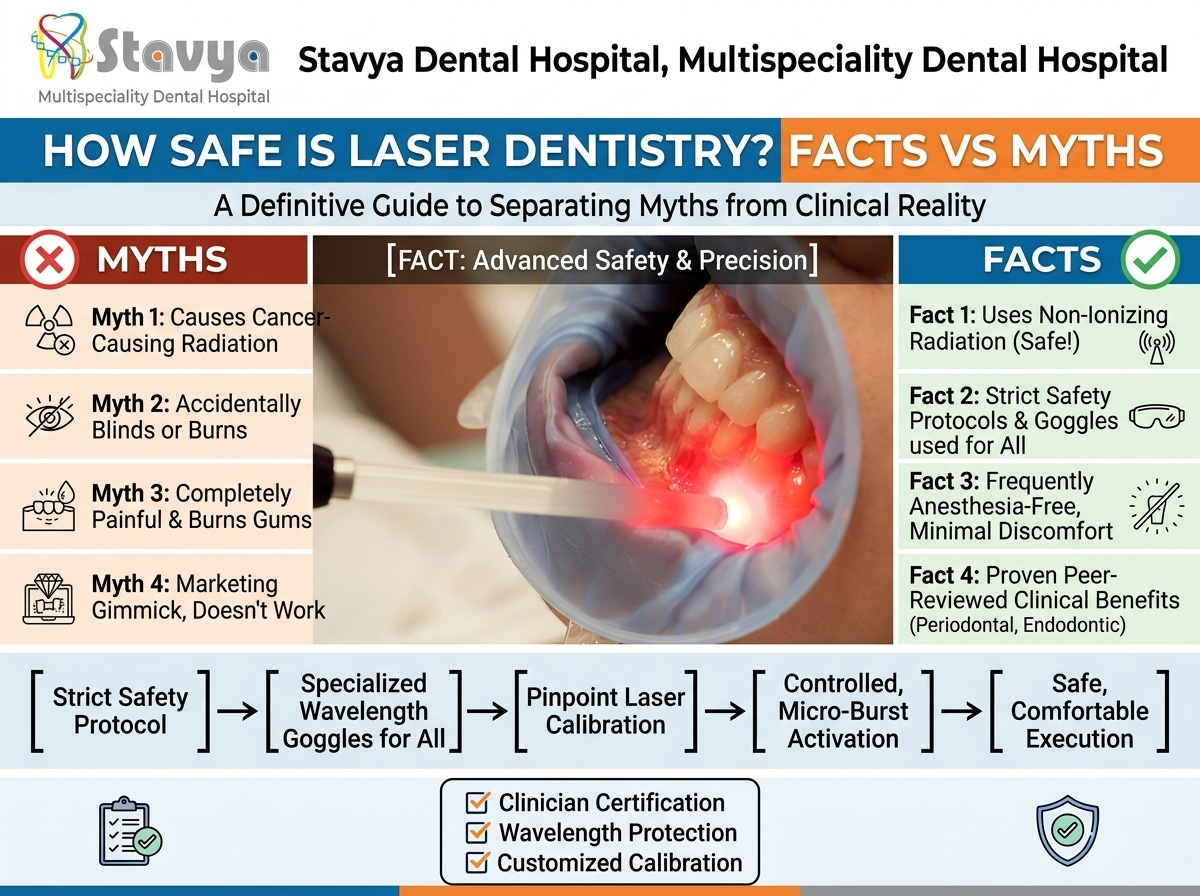
Myth 1: Dental lasers emit dangerous, cancer-causing radiation.
- The Reality: This is perhaps the biggest misconception. The word “radiation” in the laser acronym alarms people because they confuse it with ionizing radiation (like X-rays or gamma rays), which can alter cellular DNA.
- The Fact: Dental lasers utilize non-ionizing radiation. They emit pure light energy in the visible or infrared spectrum. This energy merely generates localized thermal reactions on the surface level; it has absolutely no capability to cause genetic mutations or cellular malignancies.
Myth 2: The laser can accidentally blind the patient or burn their face.
- The Reality: Because a laser is an intense beam of concentrated light, looking directly into the beam can damage the retina of the eye. However, accidents are completely prevented through strict clinical safety protocols.
- The Fact: At Stavya Dental Hospital, safety is non-negotiable. Before any laser device is activated, everyone in the room—the patient, the orthodontist, and the dental assistant—is outfitted with specialized, high-grade safety wavelength goggles. These lenses completely block out the specific laser frequency, rendering the light harmless to your eyes. Furthermore, the laser is only deployed in highly controlled, short bursts.
[Strict Clinical Safety Protocol]
               ⬇️
[Specialized Wavelength Goggles for All] ➡️ Blocks harmful frequencies
               ⬇️
[Pinpoint Laser Calibration] ➡️ Protects neighboring tissues
               ⬇️
[Controlled, Micro-Burst Activation] ➡️ Safe, comfortable execution
Myth 3: Laser dentistry is completely painful and burns your gums.
- The Reality: Patients worry that a thermal light beam will create a burning sensation or char their oral tissues.
- The Fact: Laser dentistry is so comfortable that many procedures can be performed with minimal or zero local anesthesia. The laser energy can desensitize nerve endings in real-time. While soft tissue lasers do interact with water molecules to vaporize tissue, they instantly cool the area and do not create a painful thermal burn. Post-operative discomfort is significantly lower than when traditional scalpels are used.
Myth 4: Lasers are a marketing gimmick and don’t work as well as regular drills.
- The Reality: Some believe lasers are just fancy, expensive gadgets used to inflate dental bills without offering real clinical advantages.
- The Fact: The clinical benefits of lasers are profound and verified by extensive peer-reviewed endodontic and periodontal research. Lasers achieve outcomes that manual instruments simply cannot, such as deeply decontaminating microscopic root canals and safely stimulating cellular regeneration in deep gum pockets.
Key Clinical Benefits: Why We Use Lasers at Stavya Dental
When you choose laser-assisted dental care at our hospital, you are unlocking a variety of physiological and psychological advantages:
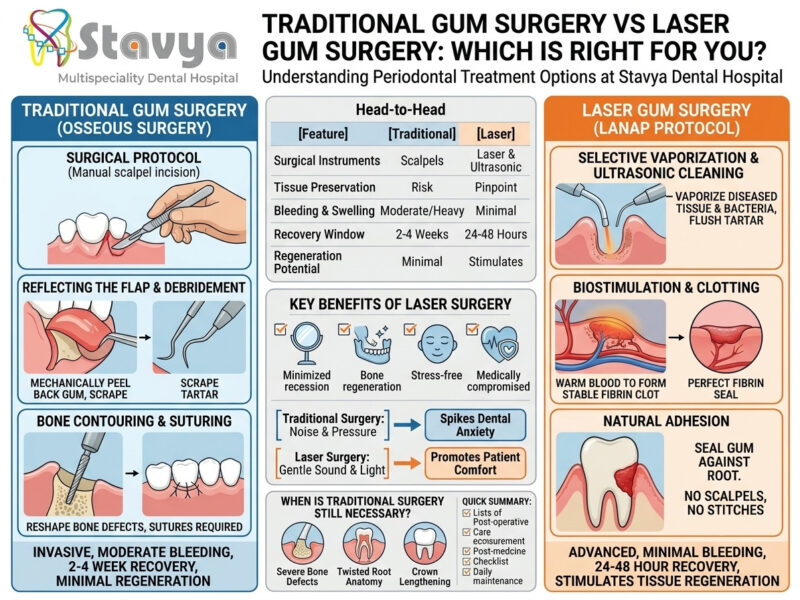
| Treatment Feature | Traditional Dentistry (Drills & Scalpels) | Advanced Laser Dentistry |
| Bleeding Control | Moderate bleeding; requires sutures to close wounds. | Instant cauterization; minimal to no bleeding; rarely needs stitches. |
| Anxiety Levels | High due to the high-pitched whining sound of the drill. | Low; lasers operate with a gentle, rhythmic whispering or tapping sound. |
| Healing Timeline | Swelling and soreness can last for several days. | Rapid cell regeneration; drastically shortened recovery window. |
| Anesthesia Needed | Almost always requires deep local numbing injections. | Frequently completed with minimal or completely needle-free numbing. |
Common Applications of Laser Technology in Dentistry
Lasers are incredibly versatile tools. Here are some of the ways we utilize laser dentistry to enhance our treatments at Stavya Dental Hospital:
A. Periodontal (Gum Disease) Therapy
In deep gum infections, bacteria hide in deep pockets between your teeth and gums. Traditional cleaning instruments can find it difficult to reach these depths without aggressive scraping. A soft-tissue laser slips into these pockets easily, vaporizing the diseased tissue lining and wiping out the bacterial colony while preserving the healthy gum tissue. It also stimulates blood clot formation, helping the gums naturally reattach to the tooth root.
B. Precision Cavity Preparation
Before filling a cavity, all decayed structure must be cleared out. A hard-tissue laser vaporizes the decayed dentin with absolute precision, leaving a highly sterile, microscopically textured surface that forms an incredibly strong bond with modern composite resin fillings.
C. Gum Contouring (Smile Designing)
If you have a “gummy smile” where your teeth look excessively short due to overextended gum tissue, lasers offer a beautiful cosmetic fix. We use soft-tissue lasers to painlessly sculpt and reshape your gum line evenly, framing your teeth perfectly with immediate results and zero down-time.
D. Accelerated Teeth Whitening
In professional cosmetic whitening treatments, specialized lasers are used to activate high-concentration bleaching gels safely. The laser energy accelerates the chemical breakdown of deep enamel stains, cutting down treatment time and reducing post-whitening tooth sensitivity.
E. Treating Canker Sores and Aphthous Ulcers
If you suffer from painful mouth ulcers, lasers can provide instant relief. A low-energy laser application directly alters the nerve endings over the sore, instantly cutting down the pain and stimulating the body to heal the ulcer in half the usual time.
Patient Safety Guidelines: What You Should Look For
While the technology itself is highly safe, its execution depends heavily on clinical expertise. To ensure you receive the safest laser treatment possible, keep the following checklist in mind:
- [ ] Clinician Certification: Ensure your dentist has undergone specific post-graduate training and certification in laser physics and safety mechanics.
- [ ] Wavelength Protection: The dental practice must strictly mandate the use of protective eyewear for every individual inside the operatory room.
- [ ] Customized Calibration: The laser settings must be precisely adjusted based on your specific tissue thickness, age, and treatment goals.
At Stavya Dental Hospital, all our senior clinicians are deeply trained in advanced endodontic and periodontal laser wavelengths, ensuring absolute adherence to international safety metrics.
Experience Safe, Comfortable Laser Dentistry at Stavya Dental Hospital
Dental anxiety should never prevent you from achieving a healthy, beautiful smile. If the sound of a traditional dental drill has kept you away from the dentist’s chair for years, laser dentistry at Stavya Dental Hospital offers the stress-free, gentle solution you have been looking for.
By blending medical excellence with premium, non-invasive technology, we transform routine dental visits into comfortable, efficient, and deeply predictable experiences. From advanced cavity treatments to flawless cosmetic gum transformations, our team ensures your absolute safety and care every step of the way.
Book Your Consultation Today
Discover how advanced laser dentistry can elevate your oral health journey. Connect with our dedicated patient relationship team to schedule your personalized evaluation.
- Official Website: www.stavyadental.com
- Direct Helpline / Appointments: +91 8980395039