Losing a tooth — whether from decay, injury, or extraction — brings up an immediate question: how soon can it be replaced? For patients considering dental implants, one of the first decisions a dentist will walk you through is timing. Should the implant go in right away, on the same day as the extraction? Or is it better to wait weeks or months for the socket to heal first?
This is the core difference between immediate dental implants and delayed dental implants, and it’s a decision that affects everything from your treatment timeline to your final aesthetic result. There’s no single “better” answer that applies to everyone — the right choice depends on your oral health, the condition of the extraction site, and your specific goals. This guide breaks down both approaches so you can have an informed conversation with your dentist.
What Are Immediate Dental Implants?
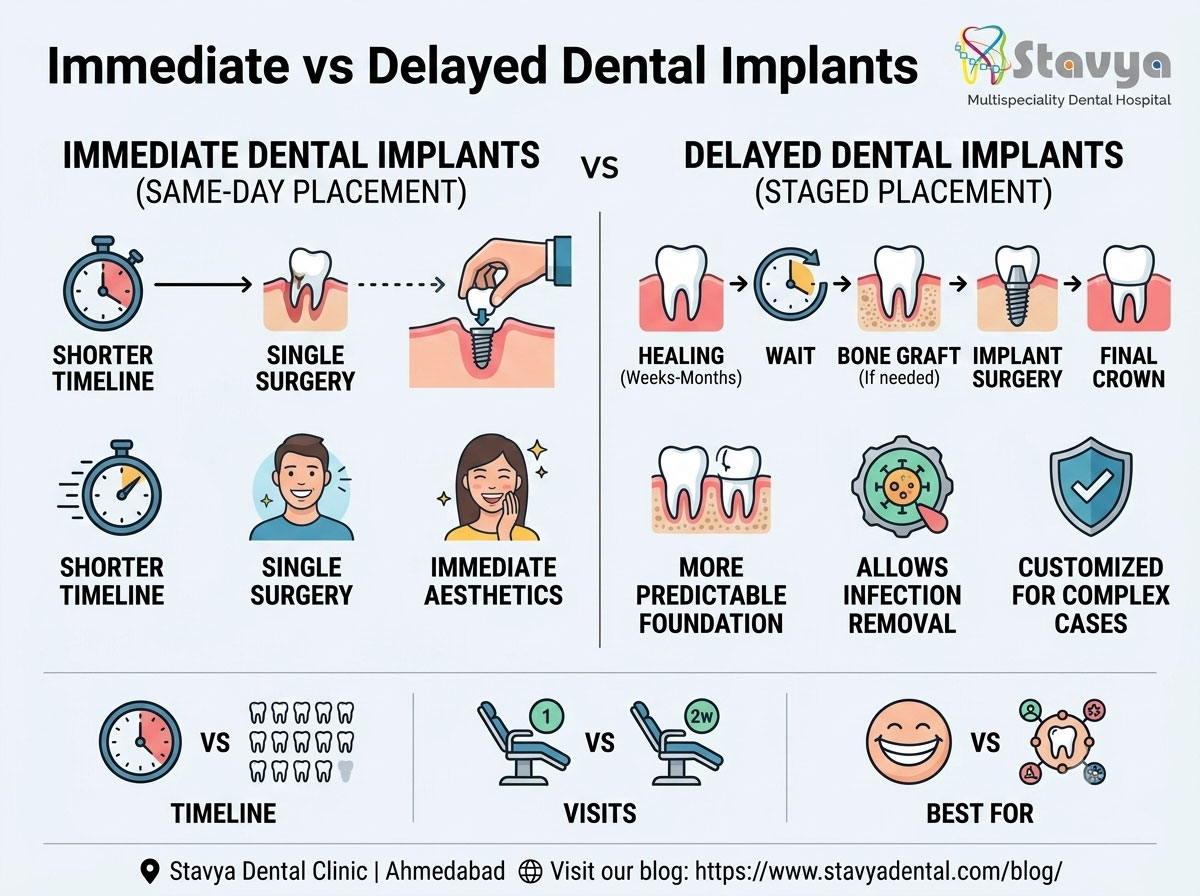
Immediate implant placement means the implant is inserted into the jawbone on the very same day a tooth is extracted — sometimes within the same appointment. Instead of removing the tooth and waiting for the gum and bone to heal before starting implant treatment, the dentist places the implant directly into the fresh extraction socket.
This approach is attractive for obvious reasons: fewer surgical visits, a shorter overall treatment timeline, and less time spent without a tooth in a visible area of the mouth. In some cases, a temporary crown can even be attached the same day, a technique often referred to as “same-day” or “teeth-in-a-day” implants.
However, immediate placement isn’t suitable for every situation. It requires:
- Sufficient healthy bone at the extraction site to anchor the implant securely
- No active infection or significant bone loss around the tooth being removed
- A socket shape and size compatible with immediate implant stability
- Good general oral and systemic health
What Are Delayed Dental Implants?
Delayed implant placement follows a more traditional, staged approach. The damaged or infected tooth is extracted first, and the site is allowed to heal — typically for 8 to 16 weeks, sometimes longer — before the implant is surgically placed. In cases where the jawbone has already lost density (common after teeth have been missing for a while), a bone graft may be needed first, adding several additional months to the timeline before the implant itself can go in.
While this takes longer, it gives the surrounding bone and soft tissue time to heal and stabilize, often resulting in a more predictable foundation for the implant. Delayed placement is generally the recommended route when:
- There’s infection, significant decay, or periodontal disease at the extraction site
- The bone volume is inadequate and requires grafting before implant placement
- The extraction site is complex (e.g., a fractured tooth root or extensive damage)
- The patient has certain health conditions that benefit from a more conservative, staged approach
Immediate vs Delayed Dental Implants: Key Differences
| Factor | Immediate Implants | Delayed Implants |
|---|---|---|
| Timeline | Implant placed same day as extraction | Implant placed weeks to months after extraction/healing |
| Number of surgical visits | Often combined into one | Typically two separate procedures |
| Best for | Healthy bone, no infection, straightforward extractions | Infected sites, low bone volume, complex extractions |
| Bone grafting | Sometimes done simultaneously | Often required and completed before implant stage |
| Aesthetic downtime | Minimal — less time without a visible tooth | Longer gap before a permanent restoration |
| Healing predictability | Slightly more technique-sensitive | Generally more predictable bone integration |
| Total treatment time | Shorter overall | Longer overall, but often more conservative |
Which Option Has a Better Success Rate?
This is usually the first question patients ask, and it’s a fair one. Clinically, both immediate and delayed implants have shown high long-term success rates when the case is selected appropriately — the key phrase being “selected appropriately.”
- Immediate implants tend to succeed very well in patients with healthy, sufficient bone and no active infection. Because the implant is placed into fresh bone with intact anatomy, integration (osseointegration) can proceed smoothly. However, immediate placement is more technique-sensitive and success depends heavily on the dentist’s assessment and surgical precision.
- Delayed implants benefit from a fully healed, stable site, which reduces variables during placement. This is often why delayed placement is preferred in more complex or compromised cases — it removes uncertainty about infection or bone quality before committing to implant surgery.
In short: success isn’t really about which method is inherently “better” — it’s about which method matches the condition of your extraction site. A well-selected immediate case and a well-selected delayed case both tend to perform excellently over the long term.
Advantages of Immediate Dental Implants
- Faster overall treatment — fewer months between extraction and a functional, restored tooth.
- Fewer surgical procedures — extraction and implant placement combined reduces the number of times you’re in the surgical chair.
- Less bone resorption — placing an implant soon after extraction can help preserve some of the natural bone contour that would otherwise begin to shrink.
- Better aesthetics in visible areas — particularly useful for front teeth, where a prolonged gap is undesirable.
- Reduced total recovery downtime — one healing period instead of two separate ones.
Advantages of Delayed Dental Implants
- More predictable healing foundation — the site is fully recovered before implant placement, reducing surgical risk.
- Allows time to resolve infection — critical when the extracted tooth was affected by decay, abscess, or gum disease.
- Time for bone grafting to fully integrate — important in patients with bone loss, ensuring the implant has adequate support.
- Lower risk of implant failure in compromised sites — waiting reduces the chance of placing an implant into unstable or infected bone.
- More conservative for patients with health conditions that affect healing (e.g., uncontrolled diabetes, smokers, certain immune conditions) — your dentist may recommend the safer, staged route.
Who Should Choose Immediate Implants?
Immediate implants are generally a strong option if you:
- Have healthy, adequate jawbone at the extraction site
- Are extracting a tooth due to trauma or a clean fracture (not infection)
- Want to minimize time without a visible tooth, especially in the smile zone
- Are in good general health with no conditions that slow healing
- Prefer fewer total dental visits
Who Should Choose Delayed Implants?
Delayed implants are usually the safer, more appropriate route if you:
- Are extracting a tooth due to infection, abscess, or advanced gum disease
- Have noticeable bone loss and will need grafting before implant placement
- Have a complex extraction (curved roots, fractured tooth, prior surgery in the area)
- Have a health condition that benefits from a more staged healing approach
- Are undergoing extraction on a back tooth where aesthetics are less urgent
Recovery Timeline Comparison
Immediate Implants (approximate):
- Day 0: Extraction + implant placement (sometimes with temporary crown)
- Weeks 1–2: Initial soft tissue healing
- Months 3–6: Osseointegration (bone fusing with implant)
- Final restoration (permanent crown) once integration is confirmed
Delayed Implants (approximate):
- Day 0: Extraction
- Weeks 8–16: Socket healing (longer if bone grafting is required — often 4–6 months for graft maturation)
- Implant placement surgery
- Months 3–6: Osseointegration
- Final restoration once integration is confirmed
As the timelines show, delayed implants generally take several months longer from start to finish, particularly when bone grafting is involved.
Cost Considerations
Cost varies by case complexity rather than purely by timing method. Immediate implants can sometimes work out more cost-effective simply because they require fewer separate procedures. However, if a delayed approach avoids implant failure in a compromised site, it can prevent the higher cost of redoing failed implant treatment later. Your dentist can give you a case-specific cost estimate after a clinical evaluation and imaging (X-ray or CBCT scan).
Risks to Be Aware Of
Immediate implants carry a slightly higher technique-sensitivity risk — if the socket isn’t perfectly suited, primary stability of the implant can be harder to achieve. This is why proper case selection through imaging and clinical assessment is essential before proceeding.
Delayed implants, while more predictable, mean a longer period without a permanent tooth in place (often bridged with a temporary partial denture or retainer), and involve committing to a longer overall treatment plan.
How Stavya Dental Clinic Approaches This Decision
At Stavya Dental Clinic, every implant case begins with a detailed clinical evaluation — including imaging to assess bone volume, socket condition, and whether infection or grafting needs to be addressed first. We don’t apply a one-size-fits-all protocol; instead, we match the timing approach (immediate or delayed) to what will give you the most predictable, long-lasting result.
If you’re missing a tooth or facing an upcoming extraction and want to understand which implant timing is right for your situation, our team can walk you through your options during a consultation.
👉 Learn more about our Dental Implants services
Related Reading on Our Blog
- Can You Get a Dental Implant Immediately After Tooth Extraction?
- Why Do Dental Implants Fail? Causes, Symptoms and Prevention
- How Long Do Dental Implants Last? 10 Factors That Affect Their Lifespan
- Sinus Lift for Dental Implants: Procedure, Recovery and Who Needs It
- Dental Bone Grafting Before Implants: When Is It Necessary?
More from our Dental Implants category: Browse all Dental Implants posts
Frequently Asked Questions
Is it painful to get an implant on the same day as an extraction? Discomfort is generally similar to a standard tooth extraction, managed with local anesthesia and standard post-operative care. Most patients tolerate immediate placement well.
Can everyone get an immediate implant? No. Immediate implants require healthy bone and the absence of active infection at the extraction site. A clinical evaluation with imaging is needed to confirm candidacy.
Does delayed placement mean I’ll be without a tooth for months? Not necessarily. Temporary options like a removable partial denture or a bonded temporary tooth can bridge the gap while the site heals and the implant integrates.
Which option lasts longer — immediate or delayed implants? Long-term durability depends more on proper case selection, implant placement precision, and aftercare than on timing alone. Both approaches can achieve implants that last well over a decade with good maintenance.
How do I know which option is right for me? The only reliable way is a clinical exam and imaging with your dentist, who can assess your bone quality, infection status, and overall oral health to recommend the safer, more predictable path.
Final Thoughts
Both immediate and delayed dental implants are proven, effective ways to replace a missing tooth — the “better” option isn’t universal, it’s personal to your specific case. Immediate implants offer speed and convenience for the right candidates, while delayed implants offer a more conservative, predictable path when infection, bone loss, or complex extractions are involved.
The best next step is a professional evaluation. At Stavya Dental Clinic, we assess your bone structure, oral health, and goals before recommending the timing approach that will give you the strongest, longest-lasting result.
📍 Stavya Dental Clinic | Ahmedabad 🌐 Visit our blog: https://www.stavyadental.com/blog/
Note: I noticed your website URL had a stray space in it (“stavyaden tal.com”) — I’ve used the correct domain (stavyadental.com) throughout this post and its links, based on your site as previously referenced. Please double check before publishing.