Losing a tooth — whether to decay, trauma, or a fracture that can’t be saved — usually comes with an immediate follow-up question: how soon can I get it replaced? For years, the standard answer was “wait a few months.” Today, that’s no longer the only option. In the right circumstances, a dental implant can be placed in the same socket on the very same day the tooth is removed.
This is called immediate implant placement, and it’s one of the most requested procedures at Stavya Dental Clinic. But “possible” and “right for you” aren’t always the same thing. Whether same-day implant placement makes sense depends on your bone health, the site of extraction, whether there’s infection present, and a few other clinical factors we’ll walk through in detail below.
What Does “Immediate Implant Placement” Actually Mean?
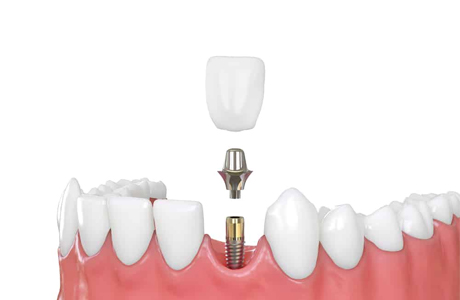
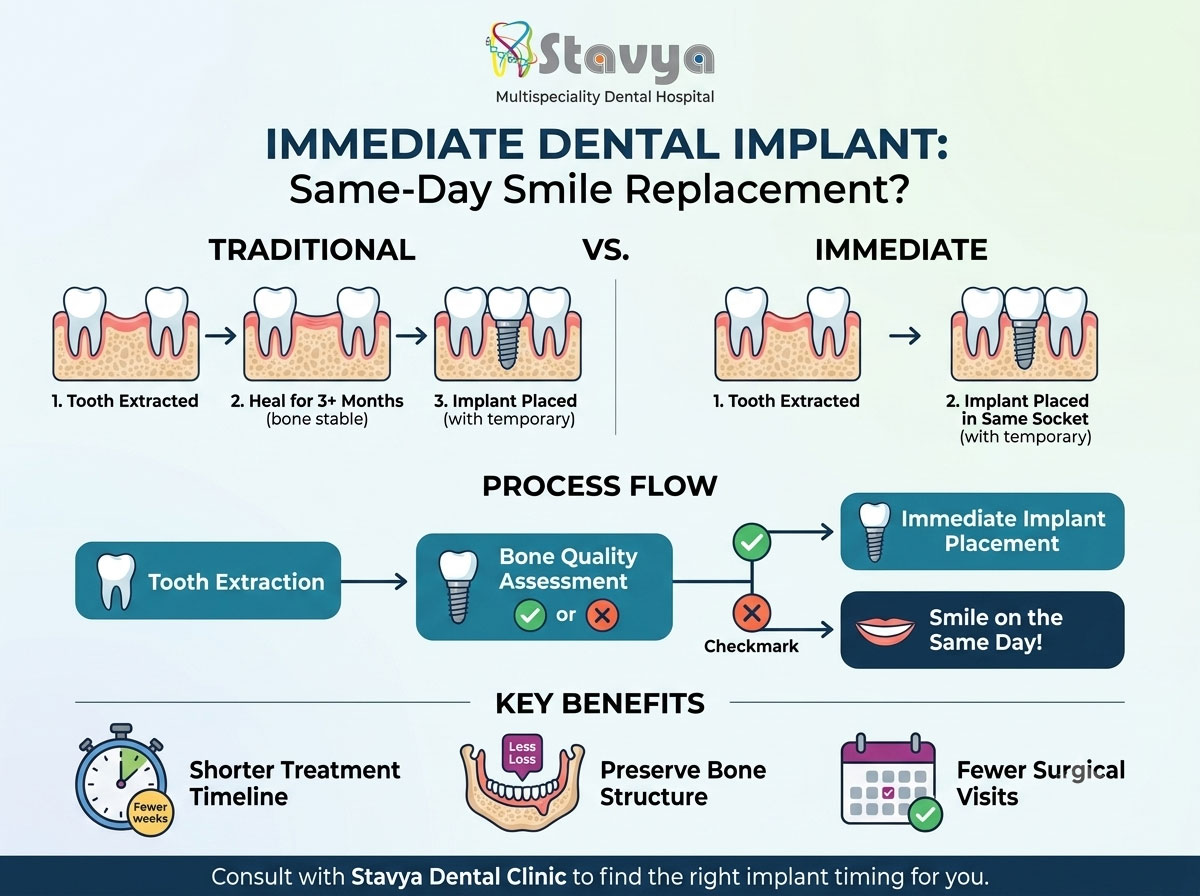
Immediate implant placement refers to inserting a dental implant into the extraction socket right after the natural tooth is removed — in the same appointment, under the same anesthesia. There’s no gap between extraction and implant surgery; both happen in one visit.
This is different from the traditional approach, where the socket is left to heal for a period of weeks to months before an implant is even considered. Dentists generally group implant timing into three categories:
- Immediate implant placement — the implant is placed the same day as extraction.
- Early (delayed) implant placement — the implant is placed 6 to 12 weeks after extraction, once the gum tissue has healed but before significant bone remodeling occurs.
- Late (conventional) implant placement — the implant is placed several months after extraction, once the socket has fully healed and the bone has re-formed.
None of these approaches is universally “better” — each is suited to different clinical situations, and matching the right timing to the right case is a core part of implant planning at our clinic.
Why Same-Day Implants Have Become So Popular
There are practical reasons patients specifically ask about immediate implants:
- Fewer surgical visits. Combining extraction and implant placement into one appointment means one surgical procedure instead of two.
- Shorter overall treatment timeline. You skip the multi-month waiting period between extraction and implant surgery.
- Less bone loss. After a tooth is extracted, the surrounding bone naturally begins to resorb (shrink) within weeks. Placing an implant immediately can help preserve more of the existing bone structure and ridge shape.
- Better soft-tissue support. In visible areas like the front teeth, immediate placement can help maintain the natural contour of the gums, which is otherwise difficult to fully rebuild later.
That said, none of these benefits are guaranteed outcomes — they’re advantages when the case is suitable. Rushing an implant into a site that isn’t ready can lead to complications that are harder to fix than if you had simply waited.
Who Is a Good Candidate for Immediate Implant Placement?
This is the question that matters most, and it can only be properly answered after a clinical examination and imaging — but here’s what we generally look for:
Good candidates typically have:
- No active infection at the extraction site (no abscess, no significant pus, no acute swelling)
- Sufficient bone volume and density around and beyond the socket to stabilize the implant
- An intact socket wall — the bone surrounding the tooth root has not been destroyed by the condition that led to extraction
- Good general oral hygiene and healthy gum tissue elsewhere in the mouth
- No uncontrolled systemic conditions (such as poorly managed diabetes) that would impair healing
- Non-smoking status, or a willingness to pause smoking during the healing period, since smoking significantly raises implant failure risk
Immediate placement is usually NOT recommended when:
- There’s active infection, an abscess, or significant pus at the site
- The tooth was lost due to advanced periodontal (gum) disease that has destroyed surrounding bone
- There isn’t enough bone to achieve good initial implant stability
- The extraction socket wall is fractured or missing (common with some traumatic extractions)
- The patient has certain uncontrolled medical conditions affecting bone healing
If your case falls into the second group, that doesn’t mean you can’t get an implant — it usually means an early or delayed approach is safer, sometimes combined with a bone grafting procedure to rebuild adequate bone volume first.
How Do We Decide? The Role of Diagnostic Imaging
You can’t judge bone quality and quantity by eye alone, which is why imaging plays a central role in implant planning. At Stavya Dental Clinic, we typically rely on:
- CBCT (Cone Beam Computed Tomography) scanning — a 3D imaging technique that lets us see the exact bone height, width, and density around the extraction site, as well as the position of critical structures like nerves and sinuses, before we ever pick up a drill. You can read more about how this compares to conventional imaging in our post on CBCT vs. Traditional Dental X-rays: Which One Is Better?
- Digital intraoral scanning — used to capture the exact shape of your bite and surrounding teeth, which helps plan the implant’s angle and final crown position with precision.
- Periapical and panoramic X-rays — for a broader initial assessment of the tooth and surrounding structures.
Digital imaging has genuinely changed what’s possible in implant dentistry. Our detailed explainer on How Digital Radiology Reduces the Need for Repeat X-rays covers why this matters not just for accuracy, but for reducing your overall radiation exposure during treatment planning.
What Happens During the Procedure?
If you’re cleared for immediate implant placement, here’s roughly what the appointment looks like:
- Local anesthesia is administered to fully numb the tooth and surrounding tissue.
- The tooth is extracted as atraumatically as possible — meaning care is taken to preserve as much of the surrounding bone and gum architecture as possible, often using specialized instruments (including piezoelectric surgical devices in more delicate cases) rather than simply forcing the tooth out.
- The socket is thoroughly cleaned and inspected to confirm the bone walls are intact and there’s no residual infection.
- The implant is placed into the socket, typically anchored into the bone slightly beyond the base of the original root for stability.
- Any gaps between the implant and the socket walls may be filled with a bone graft material to support healing and preserve ridge contour.
- A healing cap, temporary crown, or cover screw is placed on top of the implant, depending on whether immediate loading (a temporary tooth the same day) is planned or a submerged healing approach is used.
- Stitches may be placed to help stabilize the gum tissue around the implant site.
The entire appointment for a single tooth usually takes between 60 and 90 minutes, though this varies by case complexity.
Immediate Implant vs. Immediate Loading — An Important Distinction
Patients often use these terms interchangeably, but they’re not the same thing:
- Immediate implant placement means the implant is surgically placed the same day as extraction — but the final crown may still be delayed until the implant has fused with the bone (a process called osseointegration).
- Immediate loading means a temporary crown or restoration is attached to the implant on the same day, so you’re not walking around with a gap.
Not every case that qualifies for immediate placement also qualifies for immediate loading — that depends on how much initial stability the implant achieves in the bone. Your dentist will assess this during the procedure itself and let you know whether a same-day temporary tooth is appropriate, or whether it’s safer to wait a few weeks before loading the implant.
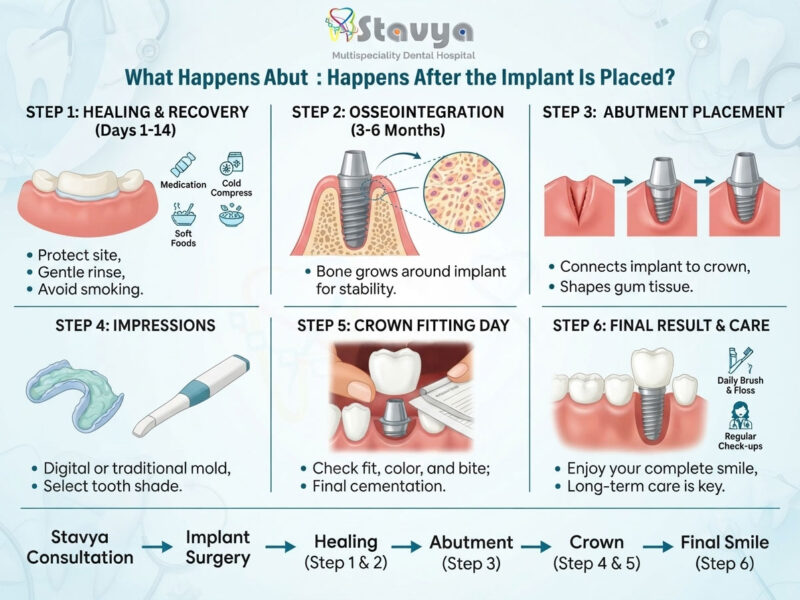
Healing Timeline After Immediate Implant Placement
Every case is different, but a general timeline looks like this:
- Week 1–2: Initial soft-tissue healing; mild swelling and tenderness are normal.
- Week 2–4: Stitches (if used) typically dissolve or are removed; gum tissue continues to settle.
- Month 2–4: Osseointegration — the process where bone cells grow around and fuse with the implant surface — is actively occurring. This is the most critical phase for long-term implant success.
- Month 3–6: Once osseointegration is confirmed (often checked at a follow-up visit), the permanent crown is fabricated and fitted.
Our post on How Long Do Dental Implants Last? 10 Factors That Affect Their Lifespan goes into more detail on what determines whether an implant holds up well over the following years and decades.
What Are the Risks?
Immediate implant placement is a well-established technique, but it isn’t risk-free. Potential complications include:
- Implant failure to integrate, particularly if bone stability at placement was borderline
- Infection at the surgical site
- Gum recession around the implant, especially in the visible front-tooth area
- Slight changes in the implant’s final position if bone remodeling doesn’t go exactly as planned
Understanding why implants fail — and how to reduce that risk — is worth reading before you commit to treatment. We’ve covered this in depth in Why Do Dental Implants Fail? Causes, Symptoms and Prevention.
In some cases, particularly for upper back teeth close to the sinus cavity, immediate placement also requires evaluating whether a sinus lift procedure is needed to ensure there’s enough bone height for a stable implant.
What About Wisdom Teeth and Molars?
Immediate implants are most predictable for single-rooted teeth (like front teeth and premolars) because the extraction socket is more uniform. Molars have multiple roots and a wider socket shape, which can make immediate placement more technically demanding — though still achievable in the right hands with the right bone support.
If your extraction involves a wisdom tooth specifically, it’s worth understanding the extraction itself first. Our articles on 7 Signs Your Wisdom Tooth Needs Immediate Removal and 10 Common Myths About Wisdom Tooth Extraction are good starting points if you’re facing that decision.
Cost Considerations
Immediate implant placement doesn’t necessarily cost more than a delayed approach — in fact, because it can eliminate a separate surgical visit, total treatment cost is sometimes lower. That said, final pricing depends on:
- Whether bone grafting is needed at the time of placement
- The implant system and materials used
- Whether a same-day temporary crown is included
- The complexity of the extraction itself
A proper cost estimate can only be given after your CBCT scan and clinical exam, since these determine exactly what your case requires.
Frequently Asked Questions
Is immediate implant placement painful? The procedure itself is done under local anesthesia, so you shouldn’t feel pain during placement. Some soreness and swelling for a few days afterward is normal and manageable with prescribed medication.
How do I know if I qualify? Only a clinical exam plus a CBCT scan can confirm this. Bone volume, infection status, and the condition of the socket walls are the deciding factors.
Can I eat normally after the procedure? You’ll be advised to eat soft foods and avoid chewing directly on the implant site for a period while it heals.
What if I’m not a candidate for immediate placement? That’s common, and it’s not a setback — early or delayed placement, sometimes paired with bone grafting, remains a highly predictable path to a long-lasting implant.
Final Thoughts
Getting a dental implant on the same day as your extraction is a genuine, well-supported option in modern dentistry — but it’s a decision that depends entirely on your individual anatomy and oral health, not a one-size-fits-all default. The safest way to find out if you qualify is a proper clinical evaluation combined with 3D imaging, so your dentist can see exactly what’s happening beneath the gumline before recommending a timeline.
If you’ve recently lost a tooth or know an extraction is coming up, Stavya Dental Clinic offers CBCT-guided implant consultations to help you understand your options — whether that’s immediate placement, early placement, or a staged approach with bone grafting.
Related services: Dental Implants | Extraction and Disimpaction | Radiology
Browse more on this topic: Dental Implants category | Dental Implants Work category | Dental Implant In Ahmedabad category
Contact Stavya Dental Clinic: info@stavyadental.com | +91 8980395039 | stavyadental.com