Losing a tooth is stressful enough without wondering whether your lifestyle habits will stand in the way of fixing it. For the millions of people who smoke, one question comes up again and again before implant treatment: can smokers get dental implants at all, or is smoking an automatic disqualifier?
The short answer is yes — smokers can get dental implants. But the fuller, more honest answer is that smoking measurably changes how well an implant heals, how long it lasts, and how much extra care is needed before, during, and after the procedure. Understanding exactly what smoking does to an implant — and what can be done to offset that risk — is the difference between a treatment plan that succeeds and one that fails months down the line.
This guide breaks down the real risks, the research behind them, and the practical steps that make implants a realistic option even for smokers.
Why Smoking Matters So Much for Dental Implants
A dental implant isn’t just a screw placed into the jaw — it needs to physically fuse with the surrounding bone in a process called osseointegration. This fusion is what gives an implant the strength to function like a natural tooth root. Osseointegration depends entirely on healthy blood flow and steady bone healing in the weeks and months after surgery.
Smoking interferes with almost every part of that process:
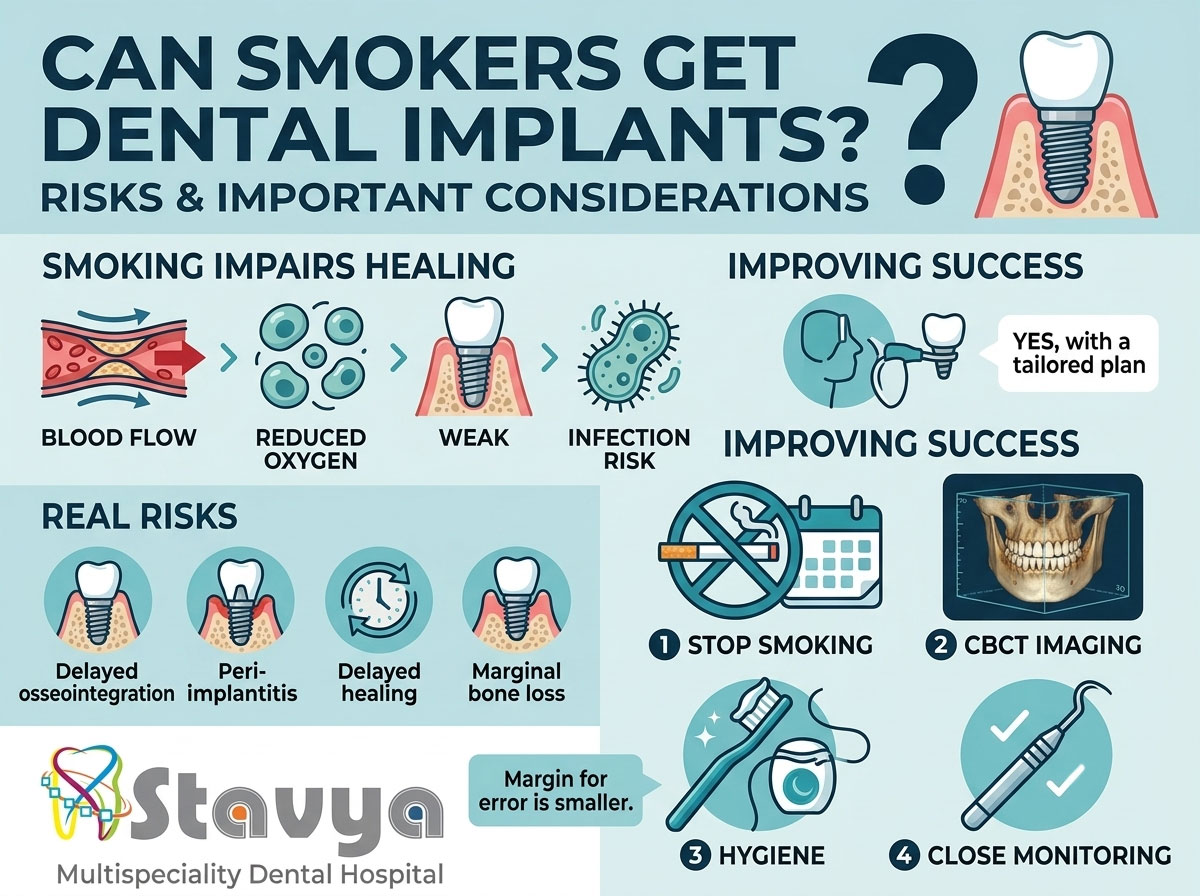
- Reduced blood flow. Nicotine causes blood vessels to constrict, which limits the oxygen and nutrients reaching the surgical site — exactly when the tissue needs them most.
- Slower wound healing. The chemicals in cigarette smoke slow down the body’s natural repair mechanisms, delaying gum and bone healing around the implant.
- Weaker bone quality. Long-term smoking is linked to reduced bone density, which affects how firmly an implant can anchor itself.
- Higher infection risk. Smoking suppresses immune function in the mouth, making it easier for bacteria to cause peri-implantitis, an infection of the tissue around an implant that is one of the leading causes of implant failure.
- Contaminated healing environment. The heat and residue from smoking directly irritate the surgical site, particularly in the upper jaw where implants sit closer to the sinus and softer bone.
None of this means implants are impossible for smokers — it means the margin for error is smaller, and planning matters more.
What the Research Actually Shows
If you search for how smoking affects dental implants, you’ll find a large and fairly consistent body of research. A few key findings are worth knowing before your consultation:
- Multiple large-scale reviews comparing tens of thousands of implants have found that smokers face roughly double to two-and-a-half times the risk of implant failure compared with non-smokers.
- The risk is dose-dependent — the more cigarettes smoked per day, the higher the failure rate. Even light smoking shows a measurably higher failure rate than not smoking at all, and heavier smoking pushes that risk up further.
- Failure risk tends to be highest in the upper jaw (maxilla), where bone is naturally softer and less dense than the lower jaw.
- Bone loss around the implant (marginal bone loss) has been shown to be roughly double in smokers compared with non-smokers, which affects long-term implant stability even when the implant initially heals successfully.
- Early failure — implant loss within the first few months, before full healing — is where smoking’s impact shows up most strongly, since this is the stage most dependent on healthy blood flow.
Overall implant success rates across the general population are high, often well above 90%. Smoking doesn’t erase that success rate, but it does shift the odds — which is exactly why an experienced implant dentist will want to plan differently for a smoker than a non-smoker.
Common Risks Smokers Should Know About
1. Delayed or Failed Osseointegration The implant may not fuse properly with the jawbone, leading to looseness or early failure — sometimes before the permanent crown is even placed.
2. Peri-Implantitis This gum infection around the implant is more common in smokers and, left untreated, can cause bone loss severe enough to require implant removal.
3. Slower Healing After Surgery Smokers often take longer to recover from the surgical placement itself, with a higher chance of soreness, swelling, or minor complications persisting longer than expected.
4. Higher Long-Term Bone Loss Even implants that heal successfully can experience faster bone loss over the years in smokers, shortening the implant’s overall lifespan.
5. Compromised Results With Bone Grafting Smokers who need a bone graft or a sinus lift before implant placement face an added layer of risk, since these procedures rely just as heavily on healthy blood supply and bone regeneration.
Can Smokers Still Get Dental Implants? Yes — Here’s How
The reality is that dentists place implants in smokers regularly. What changes is the approach:
1. A Thorough Pre-Treatment Evaluation
Before recommending implants, your dentist should assess bone density and overall oral health carefully, often using advanced imaging. At Stavya Dental Clinic, we use digital radiology and CBCT imaging to get a precise 3D view of the jawbone, which helps identify exactly how much bone is available and where the risks are highest — something traditional X-rays alone often can’t capture.
2. Reducing or Pausing Smoking Around Surgery
This is the single biggest factor within a patient’s control. Research consistently shows that stopping smoking — even temporarily — around the time of surgery meaningfully improves healing outcomes. Most dentists recommend:
- Stopping at least one to two weeks before implant surgery
- Staying smoke-free for at least 8-12 weeks after placement, covering the critical osseointegration window
- Ideally continuing to abstain until the permanent crown is placed and healing is fully complete
Even patients who can’t quit completely tend to see better outcomes by cutting down significantly during this window.
3. Choosing the Right Implant Site and Technique
Your dentist may recommend specific implant positioning, staged treatment, or additional stabilization techniques to compensate for reduced healing capacity — for example, allowing extra healing time between stages rather than rushing to immediate implant placement, or choosing a delayed implant approach over an immediate one when bone quality is a concern.
4. Stricter Oral Hygiene and Follow-Up
Smokers benefit from closer monitoring after surgery — more frequent check-ups, professional cleanings, and clear instructions on home care to catch early signs of peri-implantitis before it threatens the implant.
5. Treating Any Underlying Gum Disease First
Since smoking is also a major risk factor for gum disease, addressing any existing periodontal issues before implant placement significantly improves the odds of long-term success.
Life With Implants After Smoking-Related Treatment
Patients who follow their dentist’s pre- and post-surgical guidance — particularly around reducing smoking during the healing window — go on to enjoy the same long-term benefits as any other implant patient: stable chewing function, preserved jawbone structure, and a natural-looking, permanent tooth replacement. Understanding how long dental implants typically last and why implants sometimes fail can help smokers set realistic expectations and stay proactive about maintenance.
Frequently Asked Questions
Is it too late to get implants if I’ve smoked for years? No. Long-term smoking history is a risk factor to plan around, not an automatic disqualifier. Your dentist will assess your current bone density and gum health to determine the safest approach.
How soon after quitting smoking can I get a dental implant? There’s no fixed waiting period, but healing outcomes improve the longer you stay smoke-free before and after surgery. Many dentists recommend at least one to two weeks before surgery, at minimum.
What happens if I smoke right after implant surgery? Smoking too soon after surgery significantly increases the risk of poor healing, infection, and early implant failure, since the surgical site is at its most vulnerable in the first few weeks.
Do e-cigarettes or vaping carry the same risks? Emerging research suggests vaping can also affect healing and blood flow, though it’s studied less extensively than traditional smoking. It’s best to discuss any nicotine use, including vaping, openly with your dentist.
Will my implant definitely fail if I smoke? No — most smokers who get implants keep them successfully, especially with careful planning and reduced smoking around the healing period. The risk is higher than for non-smokers, but far from a guarantee of failure.
The Bottom Line
Smoking doesn’t rule out dental implants, but it does change the risk profile — and being upfront about your smoking habits with your dentist is the single most important step toward a successful outcome. With careful imaging, a tailored treatment plan, and a genuine effort to reduce smoking around the surgical window, smokers can achieve the same long-term implant success as anyone else.
If you’re considering dental implants and want an honest assessment of your risk factors, the team at Stavya Dental Clinic can evaluate your bone health with advanced digital imaging and build a treatment plan suited to your specific situation. Book a consultation or explore our Dental Implants services to learn more.
Related Reading on the Stavya Dental Clinic Blog
- Immediate vs Delayed Dental Implants: Which Option Is Better?
- Can You Get a Dental Implant Immediately After Tooth Extraction?
- Why Do Dental Implants Fail? Causes, Symptoms and Prevention
- How Long Do Dental Implants Last? 10 Factors That Affect Their Lifespan
- Sinus Lift for Dental Implants: Procedure, Recovery and Who Needs It
- Dental Bone Grafting Before Implants: When Is It Necessary?
- How Digital Radiology Reduces the Need for Repeat X-rays
- CBCT vs. Traditional Dental X-rays: Which One Is Better?